


Company
18 November 2026
Temporary Power Distribution Boxes: Uses and Sourcing Guide
A temporary power distribution box is a portable enclosure that takes one incoming supply …
 09:47
Chenlong Technical Team | Corporate Technical Author, Weifang Chenlong Intelligent Technology Co., Ltd. | Published: November 5, 2026 | Last reviewed: November 5, 2026
A roll forming machine shapes flat metal strip into a constant cross-section by passing it through a series of paired rollers, each bending the strip a little further. In a complete line, the strip is first decoiled, leveled, fed and punched, then roll formed, then cut to length and stacked.
Roll forming is a cold process. The metal is not heated; it is bent at room temperature, gradually, as it travels through a row of roll stands. Each stand holds an upper and lower roll whose contours match the shape the strip should have at that point. Station one might lift the edges a few degrees, station two a few more, and so on until the final stand produces the finished profile.
Engineers plan this sequence as a flower pattern: a drawing that overlays the strip’s cross-section at every station, so it opens out like petals. The flower decides how many stations a profile needs and how much bending each one does. Bend too much in one station and the strip stretches, wrinkles or twists. Spread the bending over more stations and the line gets longer and more expensive.
That trade-off explains most of what follows: almost every design choice in a roll forming line is about controlling the strip so each station receives material in a predictable state.
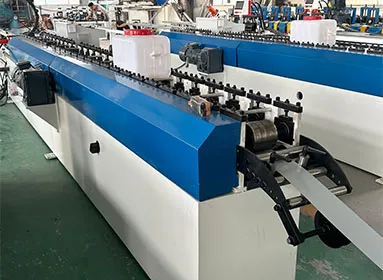
Chenlong describes its production lines as integrating decoiling, leveling, feeding, punching, roll forming, cutting, bending, welding, collecting/stacking and packaging into one automated workflow. Most profile lines use six of those as a core sequence, with bending and welding added for specific products.
| Stage | What happens | Chenlong component category |
| 1. Decoiling | Coil is held and unwound into strip | Hydraulic & Mechanical Uncoilers |
| 2. Leveling | Coil set and waviness are removed | High-Precision Straightener & Leveling Machines |
| 3. Feeding | Strip is advanced in exact increments | High-Precision Servo Feeders |
| 4. Punching | Holes, slots and notches are made | CNC & Hydraulic Punching Machines |
| 5. Roll forming | Strip is bent progressively into the profile | Cold Roll Forming Machines |
| 6. Cutting & stacking | Profile is cut to length and collected | Hydraulic & CNC Cutting Machines; Receiving Table & Palletizer |
| Optional | Further bending or joining of the cut part | Customized Bending Machines; CNC Laser Welding Machines |
1. Decoiling
The uncoiler holds the coil on an expanding mandrel and pays out strip as the line demands it. Hydraulic uncoilers expand the mandrel and handle heavier coils with less manual effort; mechanical uncoilers are simpler. The important job here is tension control: strip that surges or goes slack upsets everything downstream.
2. Leveling
Coiled steel remembers being coiled. A leveler passes the strip through staggered rolls that bend it back and forth until that curvature (coil set) is gone. Skipping or under-specifying this stage is a common cause of bowed parts later, because the forming rolls inherit whatever shape the strip arrives with.
3. Feeding
In lines with punching, a servo feeder advances the strip in precise steps so holes land where the drawing says. On Chenlong’s cabinet, cable tray and shelving lines, the published servo feeder options are Yaskawa, Delta or a customized alternative.
4. Punching
Holes, slots and notches are usually punched while the strip is still flat. Punching after forming is harder because the press has to reach into a three-dimensional profile. More on this placement choice below.
5. Roll forming
This is the machine the name refers to. The strip enters the first stand, and the driven rolls both shape it and pull it forward. Profiles range from simple channels to closed or multi-bend sections; the profile families Chenlong publishes include C/Z purlins, rack uprights and beams, cable tray sections, cabinet frames, light steel keels, door and window frames, and automotive guide-rail and chassis-support sections.
6. Cutting and stacking
A cut-off press or saw separates finished lengths, and a receiving table or palletizer collects them. On high-output lines, stacking is often where labor savings show up, because manual handling of long profiles is slow and awkward.
Two parts of the line can go either before or after the forming mill, and that choice shapes speed, tooling cost and part quality.
| Decision | Before forming (pre-) | After forming (post-) |
| Punching | Flat strip is easy to punch; simpler dies. Holes near bend lines may distort as the strip forms. | Hole position relative to bends stays exact; dies must match the formed shape, so tooling is more complex. |
| Cutting | Cut flat blanks, then form each piece. One cutting die fits many profiles; cut ends can flare because the first and last bit of each blank is formed without support. | Cut the finished profile. Clean, square ends; the cutting die must match the profile, so each profile needs its own die. |
A related choice is stop-to-cut versus flying cut. In stop-to-cut, the line pauses at every cut. In a flying cut, the cutter moves with the strip, so the line keeps running. Flying cut raises output but adds mechanical and control complexity.
There is no universally correct layout. The right one depends on hole positions, profile depth, required end quality and how many different profiles share the line.
Chenlong lists Cold Roll Forming Machines as the first item in its equipment-component category, alongside the other modules in the table above. No standalone parameter sheet (stations, shaft diameter, roll material, drive power) is published for the forming machine as a separate component.
Parameter ranges are published at production-line level for specific lines. The fire & electrical cabinet, cable tray and warehouse/supermarket shelving lines each list 10–2,000 mm material width, 0.2–10 mm rolling thickness and 0–50 m/min capacity, with all parameters customizable to project requirements. Those figures belong to those lines and describe what can be configured, not what a single forming machine does at once.
On its light steel keel line, Chenlong lists the materials that can be roll formed depending on configuration: cold-rolled steel, hot-rolled steel, galvanized steel, stainless steel, pre-coated steel, aluminum alloy, copper and high-strength sheet. That list is a fair picture of how wide the material range for cold roll forming can be.
If you need forming-machine specifications for a project, they are set during quotation from your profile drawing and material.
Understanding the process is most useful when something goes wrong. These defects show up across profile types:
A machine that produces one of these consistently is not necessarily faulty. Often the flower pattern, leveling or punch position needs revisiting for that specific profile and material.
Compared with press brake bending, the other common way to bend sheet into profiles, roll forming suits long runs of one cross-section.
| Dimension | Roll forming line | Press brake |
| Process | Continuous, from coil | One bend per stroke, from cut blanks |
| Part length | Long lengths are routine; cut to any programmed length | Limited by brake length |
| Setup for a new profile | New roll set or adjustment; longer setup | New tooling or program; faster setup |
| Best fit | High volumes of one profile | Short runs, many different parts, prototypes |
| Inline operations | Punching, cutting, stacking integrated | Usually separate operations |
The honest downside of roll forming: rolls are made for a profile, so it rarely pays off for small batches or one-off parts. If your volumes are low, buying finished profiles or using a press brake is often the more sensible route.
Q: What is a roll forming machine in simple terms?
A: A machine that bends a long metal strip into a fixed cross-section by passing it through a row of shaped rollers, each adding a little more bend.
Q: What is the difference between a roll forming machine and a roll forming line?
A: The roll forming machine is the forming mill with the roll stands. A line adds the uncoiler, leveler, feeder, punching, cutting and stacking around it.
Q: Is roll forming hot or cold?
A: Cold. The strip is formed at room temperature, which is why it is often called cold roll forming.
Q: Why does a roll forming machine need so many stations?
A: Each station bends the strip only slightly. Spreading the bending out prevents stretching, wrinkling and twisting. Thicker, stronger or more complex profiles generally need more stations.
Q: Can one roll forming machine make different profiles?
A: Sometimes. Some designs adjust for different widths or heights of a similar profile; a completely different cross-section usually needs a different roll set or line.
Q: How much does a roll forming machine cost?
A: Chenlong does not publish prices; each line is quoted from the profile drawing, material, dimensions, speed, punching needs, automation level and configuration. Published terms are a 30% deposit, T/T or L/C payment, and lead times of 20–30 business days for standard and 40–60 for custom equipment.
A temporary power distribution box is a portable enclosure that takes one incoming supply …
Seven electrical panel board types explained for cabinet and switchgear manufacturers, plu…
We will reply you within 24 hours. If for urgent case, please add WhatsApp/WeChat: +8613863639320,. Or call +8613863639320 directly.
*We respect your confidentiality and all information are protected.
We will only use your information to respond to your inquiry and will never send unsolicited emails or promotional messages.