











Entreprise
20 September 2026
Warehouse Racking Systems & Shelving Production Guide
Moving a warehouse shelving line from standard to custom profiles changes four things: too…
 09:56
09:56 Chenlong Technical Team | Corporate Technical Author | Published September 4, 2026
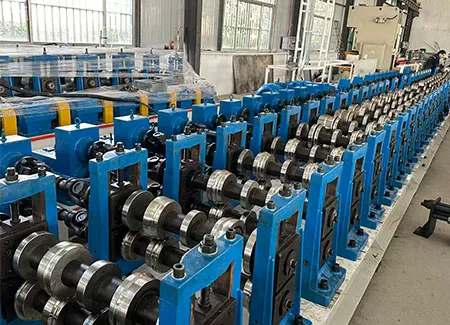
Cold roll forming equipment shapes flat steel coil into a continuous fixed profile at room temperature, using paired rollers rather than heat or a single-stroke press. The “cold” distinguishes it from hot rolling, which reshapes steel above its recrystallization temperature at the mill stage, long before the coil ever reaches a roll forming line.
Every roll forming machine on the market processes coil that’s already been cold-rolled or hot-rolled at the steel mill — that’s a property of the input material, not the forming equipment itself. What “cold roll forming” describes is the forming process: the strip passes through rollers at ambient temperature, work-hardening slightly as it bends rather than being heated to reshape more easily.
This matters for buyers because it sets expectations on tolerances and material behavior. Cold-formed profiles hold tighter dimensional tolerances than hot-formed shapes, but the material also has less ductility to work with — which is part of why progressive forming across multiple roll stands exists, rather than trying to hit the final shape in one or two passes.
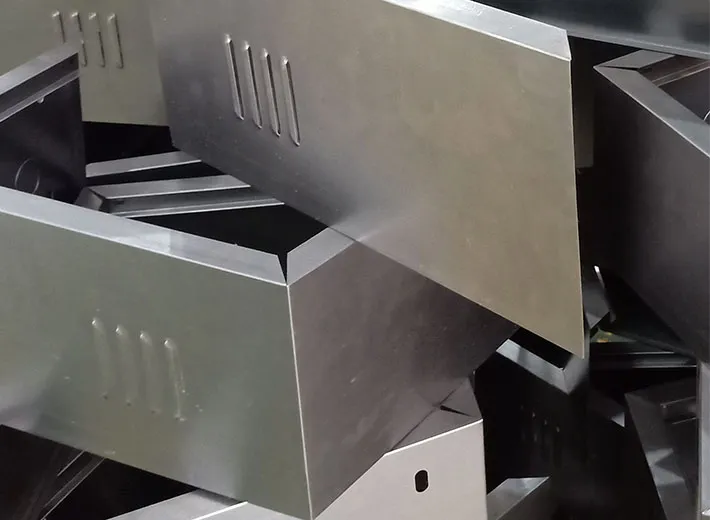
Two roll forming lines can look similar on a spec sheet and still be very different purchases, because the variables that matter aren’t always the ones listed first in a brochure.
| Variable | Why It Changes the Quote |
| Raw material width range | Determines maximum profile size the line can produce |
| Rolling thickness range | Sets which gauge steel the line can form without stalling or cracking |
| Production speed (m/min) | Affects throughput and, often, tooling precision requirements |
| Inline punching | Adds a station, synchronization requirement, and cost |
| Servo feeder brand | Yaskawa, Delta, and other options differ in repeatability and price |
| Niveau d'automatisation | Manual changeover vs quick-change tooling vs fully automated stacking |
| Material compatibility | SPCC, SPHC, SGCC, stainless, aluminum each behave differently through the same rolls |
On Chenlong’s published production lines — cabinet/electrical, chemin de câbles, et warehouse shelving equipment — the published configurable ranges span raw material width of 10–2,000 mm, rolling thickness of 0.2–10 mm, and production capacity of 0–50 m/min, with servo feeder options including Yaskawa, Delta, or customized alternatives. These ranges are configured per project rather than fixed for every application, which is standard across the industry rather than a Chenlong-specific limitation.
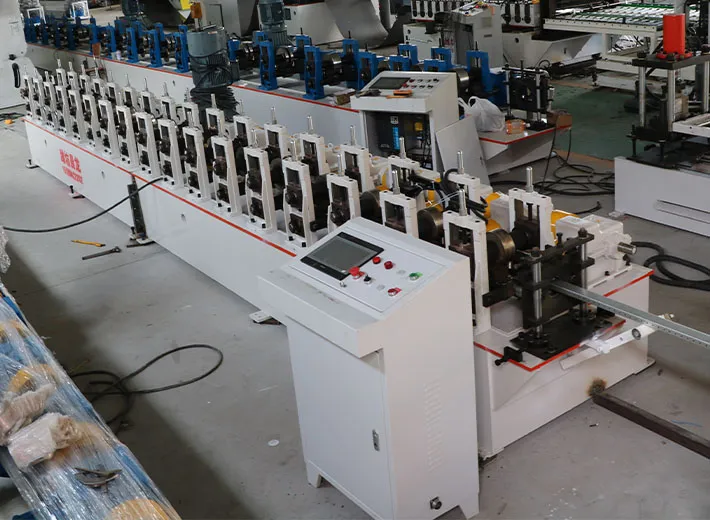
A vague request — “I need a roll forming machine” — gets a vague answer. Suppliers configuring equipment to your project need specific inputs to quote accurately:
Skipping step 2 is the most common gap — buyers quote based on their most common gauge, then discover mid-project that an occasional thicker run falls outside the machine’s validated range.
It’s tempting to assume a fully automated line — inline punching, automatic stacking, minimal manual intervention — is the better purchase by default. For high-volume, single-profile runs, that’s often true. But for lower-volume or frequently-changing profile work, the added tooling and changeover complexity of a highly automated line can slow things down rather than speed them up, since more automated stations generally mean more setup steps when switching jobs. Matching automation level to actual run volume and profile variety matters more than maximizing automation for its own sake.
Compared to buying an off-the-shelf machine from a catalog, a custom-configured line changes more than just the tooling — it typically changes the delivery timeline and the level of drawing review involved before production starts. Chenlong’s published lead times run 20–30 business days for standard equipment and 40–60 business days for custom equipment, with commercial terms of T/T or L/C and a 30% deposit on order confirmation, balance due after inspection and before shipment. Buyers evaluating multiple suppliers should confirm whether a quoted timeline starts from order confirmation or from final drawing approval — those aren’t always the same date.
A: No. It means the forming process itself — bending the coil into profile shape — happens at ambient temperature. The steel coil may have been hot-rolled or cold-rolled earlier at the mill; that’s a separate step from the forming line.
A: Often yes, within a published material compatibility list, but running different materials may require different roll pressure or speed settings even on the same tooling. Confirm this is validated, not assumed, for your specific material mix.
A: Pricing is project-quotation based across the industry, since configuration depends on profile drawings, material specs, dimensions, speed, and automation level. There’s no fixed catalog price to quote without those inputs.
A: It can be, depending on tooling condition and remaining service life — see our dedicated guide on what to check when evaluating new versus used equipment.
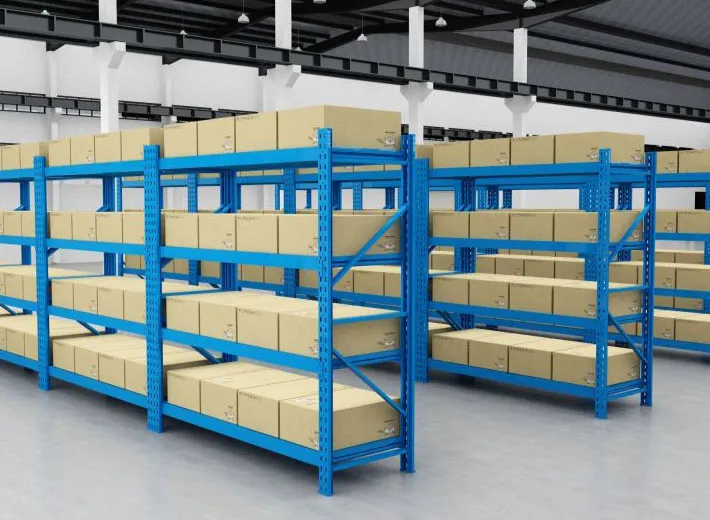
Moving a warehouse shelving line from standard to custom profiles changes four things: too…
Chenlong’s roof and wall panel line is a factory-based automated roll forming system…
Nous vous répondrons dans les 24 heures. En cas d'urgence, veuillez ajouter WhatsApp/WeChat : +8613863639320,. Ou appelez directement +8613863639320.
*Nous respectons votre confidentialité et toutes les informations sont protégées.
Nous n'utiliserons vos informations que pour répondre à votre demande et n'enverrons jamais de messages électroniques ou promotionnels non sollicités.