











Entreprise
02 September 2026
Warehouse Racking Systems and Warehouse Shelving: How to Choose the Right Storage Solution
Poor storage planning wastes floor space, slows picking, and increases product damage. The…
 16:11
16:11 Chenlong Technical Team | Corporate Technical Author | Published: August 21, 2026
A cable tray roll forming line combines decoiling, straightening, servo feeding, inline punching, and progressive roll forming into one automated setup. Chenlong’s version of this line handles raw material widths from 10 to 2,000 mm and thicknesses from 0.2 to 10 mm, producing tray-type, ladder, perforated, solid-bottom, and channel profiles from one modular setup.
A cable tray roll forming line takes flat steel, stainless steel, or aluminum coil and turns it into finished tray profiles without a separate stamping or welding pass for the base shape. The coil unwinds, gets straightened, feeds through a punching station for mounting or ventilation holes, then passes through a series of forming rollers that bend the strip into its final cross-section before a flying shear cuts it to length.
The part buyers evaluate rarely gets explained well: the line isn’t one fixed machine, it’s a chain of stations that gets reconfigured — roller sets, punch dies, feed pitch — depending on which tray profile and material gauge you’re running. A line rated for 0.2–10 mm steel and 10–2,000 mm width doesn’t run those extremes with the same tooling; it runs across that range because the tooling and feed settings change per job.
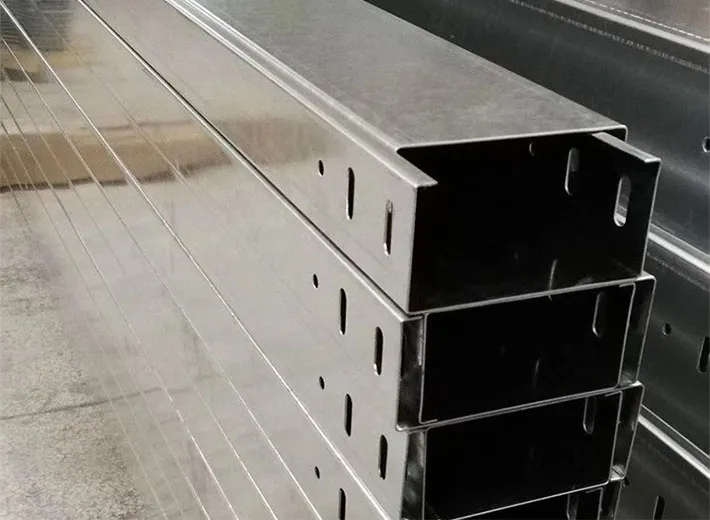
For a cable tray application, the equipment stack typically runs in this order:
Chenlong’s product description for this line calls out a modular, adjustable forming design meant to support different chemin de câbles specifications from the same base equipment, rather than requiring a separate dedicated line per tray width.
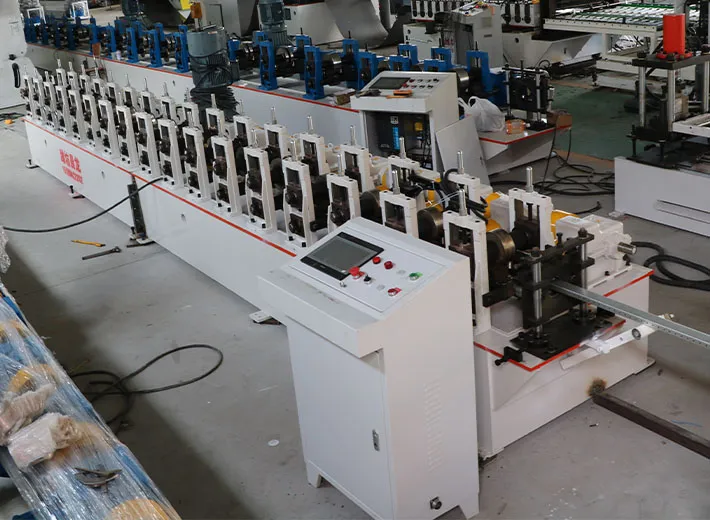
Chenlong’s cable tray line is built around five applications: tray-type, ladder, perforated, solid-bottom, and channel-type profiles. They don’t all use the punching and forming stations the same way:
| Tray Type | Punching Requirement | Forming Focus |
| Solid-bottom tray | Minimal to none (base is unperforated) | Base flatness, side-wall height |
| Perforated tray | Punching pattern across the base, before forming | Consistent hole spacing under load |
| Tray-type (general) | Optional mounting holes | Standard side-wall and flange profile |
| Channel-type | Light or no punching | Narrower, deeper channel cross-section |
| Ladder tray | Punching or notching for rung attachment points | Side-rail profile only; rungs are a separate component |
A common misreading of a spec sheet like this is assuming one roller set covers all five types with no changeover. It doesn’t. Chenlong’s product page confirms the line supports all five applications and describes the forming design as adjustable, but it does not publish a station-by-station breakdown for each individual tray type, including how ladder-tray rungs are attached to the formed side rails. That detail is configured per project, and buyers sourcing a ladder-tray line specifically should confirm rung-attachment method and any added station before finalizing a quote.
These are the published parameters for Chenlong’s Cable Tray Cold-Forming Equipment Production Line. They apply to this specific line — production capacity, motor power, or accuracy figures listed for Chenlong’s other equipment (shelving lines, purlin lines) are not automatically transferable to this one.
| Parameter | Range |
| Compatible materials | SPCC, SPHC, SGCC, SUS (stainless), aluminum, SECC |
| Largeur de la matière première | 10–2,000 mm |
| Rolling thickness | 0.2–10 mm |
| Capacité de production | 0–50 m/min |
| Servo feeder | Yaskawa, Delta, or customized |
| Punching | Inline, servo-synchronized |
| Forming design | Modular, adjustable for different tray specifications |
Two things aren’t published at the line level and shouldn’t be assumed: exact punching or forming accuracy (Chenlong’s site states ±0.1 mm at the catalog level in one section and ±0.5 mm in another, without tying either figure to a specific machine, so treat any accuracy claim as something to confirm per configuration) and motor power or voltage requirements, which are listed for other Chenlong lines but not disclosed specifically for this one.
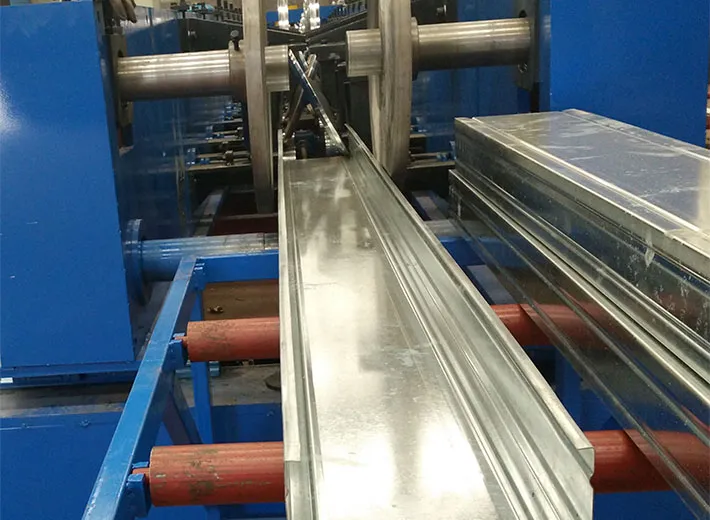
The most frequent mistake isn’t in the roll forming stations, it’s upstream and downstream of them.
Treating punch spacing as fixed. Perforated cable trays depend on repeatable hole spacing for both ventilation and structural rating. That spacing is a function of the servo feeder’s pitch accuracy, not just the punch die design. A feeder spec’d for a lighter-gauge, higher-speed job may not hold the same pitch tolerance once the line is running 6–10 mm stainless.
Skipping guarding and access review at the punch station. Inline punching combines a moving strip with a reciprocating tool, which is exactly the kind of interaction ISO 12100 addresses in its general risk-assessment framework for machinery design — identifying pinch points and access risks before equipment is finalized, not after installation. This matters more for a custom-configured line than for a fixed catalog machine, since tooling changes can shift where the actual pinch points sit.
Assuming one roller set switches tray types with no downtime. As covered above, changing between solid-bottom and perforated, or reconfiguring for ladder-tray rails, involves tooling and possibly punch die changes. Chenlong doesn’t publish a standard changeover time for this line, so it’s worth asking directly if you plan to run multiple tray types on the same equipment.
Most search results for this equipment fall into two buckets: B2B marketplace category pages that show a price range and two or three headline specs, and short supplier product pages that name the tray types produced without explaining how the line gets from flat coil to a specific profile. Compared to that kind of listing, a configuration built around a stated 10–2,000 mm width range and 0.2–10 mm thickness range is worth more to an evaluator when it’s paired with the actual station sequence and which stations change per tray type — otherwise the range is just a number with no bearing on your specific job.
Chenlong prices cable tray lines on a project basis. Final cost depends on tray profile drawings, material and gauge, target line speed, punching complexity, and how much of the upstream/downstream automation (decoiling, stacking) is included. There’s no published price range for this specific line, so treat any number you see elsewhere as an estimate, not a quote.
What is published on Chenlong’s service terms:
Expedited production may be available for urgent orders, but that’s arranged case by case rather than offered as a standard option.
A: The line is built to support all five as applications, using a modular forming design and inline punching. Switching between types involves tooling and punch die changes; the exact changeover process and time aren’t published, so confirm this against your production mix before ordering.
A: 0.2–10 mm, across SPCC, SPHC, SGCC, stainless (SUS), aluminum, and SECC. Heavier gauges toward the 10 mm end typically need the leveling station tuned differently than thin-gauge perforated tray stock.
A: Inline. Punching happens before the roll forming stations, synchronized to the servo feeder so hole or slot position stays consistent along the tray length.
A: Chenlong’s site states CE approval at the company level but does not publish a certificate number, issuing body, or the specific directive/regulation the machine is certified under. For EU-bound orders, note that machinery placed on the EU market currently falls under Machinery Directive 2006/42/EC, with Regulation (EU) 2023/1230 replacing it from January 20, 2027 — ask your supplier which framework applies to your delivery date.
A: 20–30 business days for standard configurations, 40–60 business days for custom builds, based on Chenlong’s published service terms. These are supplier-stated figures, not independently verified delivery data.
A: Not published for this line. Chenlong prices cable tray equipment per project, based on your profile drawings, gauge, speed, and automation scope — get a quote rather than relying on a generic figure from a marketplace listing.
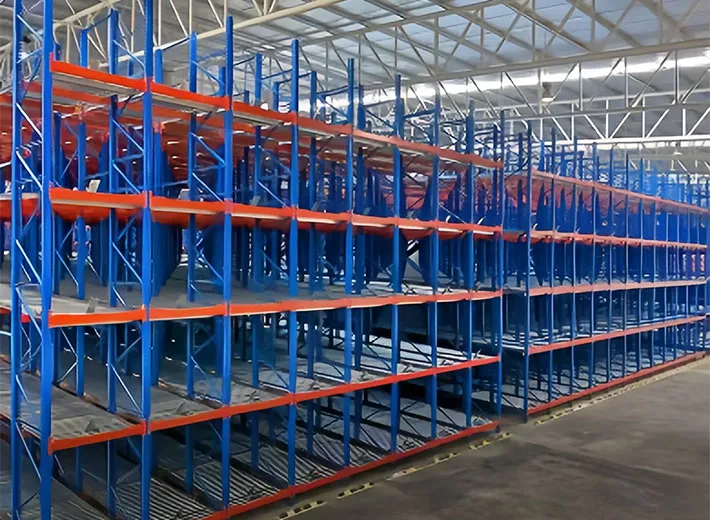
Poor storage planning wastes floor space, slows picking, and increases product damage. The…
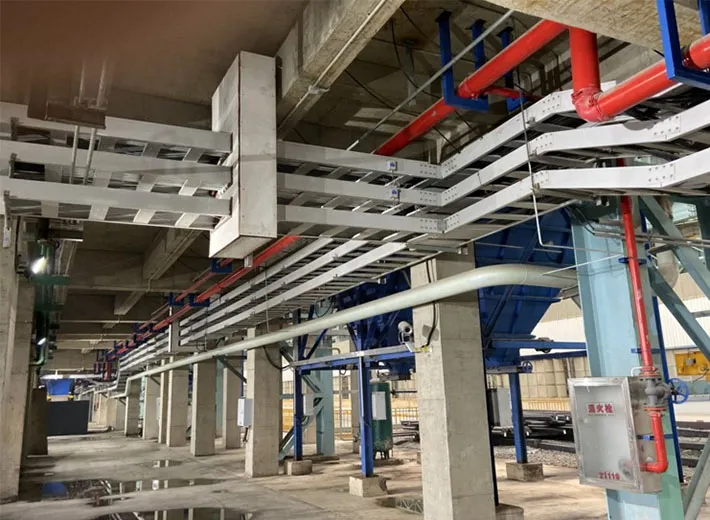
Loose electrical lines create blocked access, poor airflow, slow maintenance, and higher d…
Nous vous répondrons dans les 24 heures. En cas d'urgence, veuillez ajouter WhatsApp/WeChat : +8613863639320,. Ou appelez directement +8613863639320.
*Nous respectons votre confidentialité et toutes les informations sont protégées.
Nous n'utiliserons vos informations que pour répondre à votre demande et n'enverrons jamais de messages électroniques ou promotionnels non sollicités.