











Empresa
02 September 2026
Warehouse Racking Systems and Warehouse Shelving: How to Choose the Right Storage Solution
Poor storage planning wastes floor space, slows picking, and increases product damage. The…
 10:15
10:15 A roll forming line is a sequence of stations, not a single machine. Chenlong’s equipment catalog groups them into ten types: uncoiler, leveler, straightener, servo feeder, punching machine, roll forming mill, bending machine, laser welder, cutting machine, and receiving table with palletizer. This glossary explains what each does and where the published numbers apply.
Information current as of August 2026. Every parameter below is taken from Chenlong’s published product pages and is tied to the specific line it appears on. Where a page does not disclose a value, this article says so rather than borrowing a figure from a different machine.
Read it in process order, from coil to pallet. That is how a quotation is built and how a factory floor is laid out, so it is also the order in which most specification gaps show up. Each entry gives the station’s job, what varies between configurations, and the question worth asking a supplier about it.
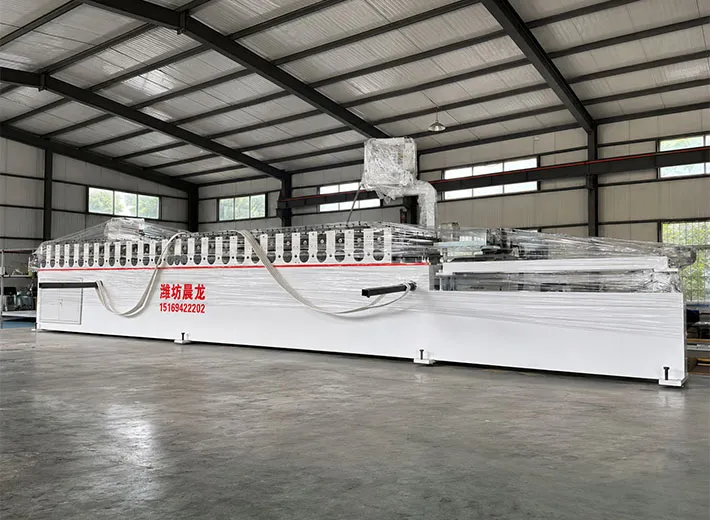
The uncoiler holds the steel coil and releases strip into the line at a controlled rate. Mechanical types rely on the pull of the downstream mill and a friction brake; hydraulic types expand and contract the mandrel under pressure and can carry heavier coils with less manual setup. Coil weight, inner diameter, and whether a coil car is included are the three variables that change the price here, and none of them are published as a fixed range — they are set per project.
Ask: what coil weight and inner/outer diameter is the mandrel rated for, at the material thickness you actually run?
Coiled steel carries coil set and cross-bow. A leveler works the strip through offset upper and lower rolls to relieve residual stress before the material reaches the forming stands. Skip this stage on thin galvanized stock and the twist shows up later as a bowed finished profile, which is usually blamed on the roll tooling instead.
Chenlong lists straightening and leveling as a separate catalog item from the leveler above. In practice the distinction is about where the correction happens: a straightening unit is often integrated as part of the feed group and handles residual camber immediately ahead of the feeder, while a standalone leveler is sized for the coil width and does the heavy stress relief. On narrow-strip lines the two are frequently combined into one frame.
The servo feeder advances a measured length of strip and stops it accurately enough for the punch to hit the same position on every part. Chenlong publishes brand options for this station: Yaskawa, Delta, or a customized alternative, listed on the cabinet line, the cable tray line, and the shelving line alike. Feeder choice is one of the few components where a buyer can specify a named supplier without redesigning the line.
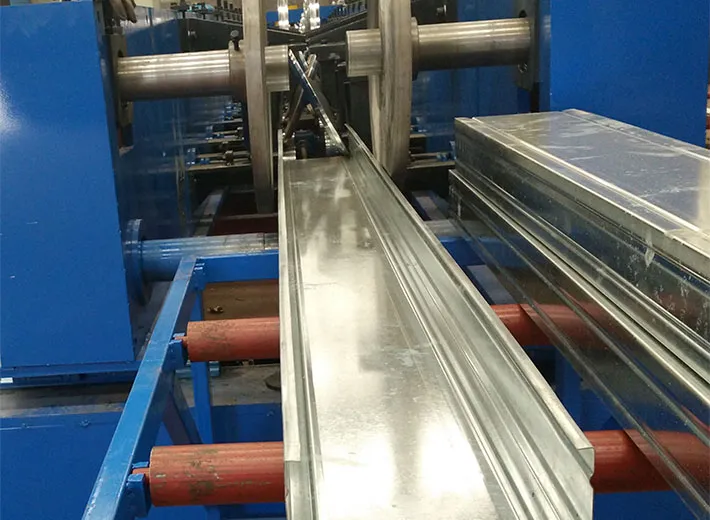
Inline punching produces the slots, keyholes, and mounting holes that make a profile usable — the perforations in a cable tray, the pitch holes on a rack upright. CNC punching changes pattern by program; hydraulic punching changes pattern by changing tooling, which is cheaper to buy and slower to switch.
Die material is published for the shelving line: Cr12MoV, SKD11, or DC53, selected according to the material and application. That choice governs how many hits the die survives before regrind, so it belongs in the quotation rather than in a verbal assurance.
The forming mill is the core of the line. A series of roll stands bends flat strip progressively into the finished cross-section, each stand taking a small share of the total deformation. Stand count follows from the profile geometry, the material thickness, and the yield strength of the grade — not from a catalog tier.
Chenlong describes the cable tray line as using a modular adjustable forming design intended to cover different tray specifications, which matters if a buyer expects one line to serve several product widths.
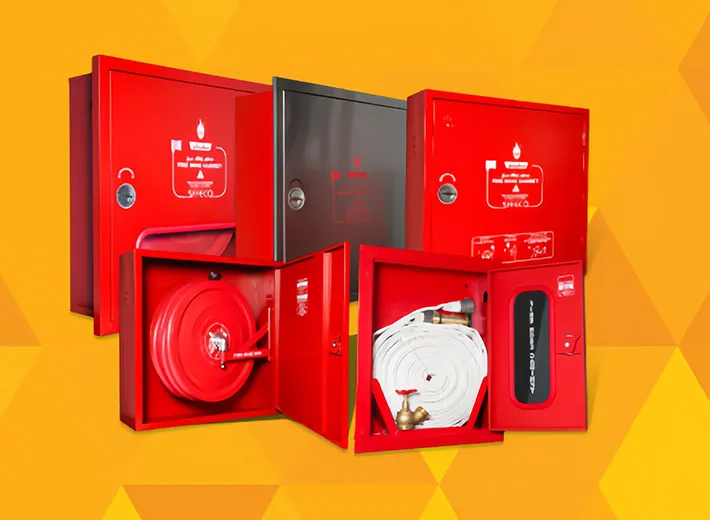
Bending handles features the mill cannot form in a continuous pass: end returns, corner folds, flanged closures on cabinet and enclosure parts. On enclosure work such as armarios de protección contra incendios casings, this station often determines whether the line ends with a finished component or a semi-finished blank that still needs a press brake elsewhere in the plant.
Laser welding joins seams and attaches reinforcement inline. It concentrates heat in a narrow zone, which limits distortion on thin gauge material compared with conventional seam methods. Whether a line needs welding at all is a product question, not an equipment question — many tray and purlin profiles ship unwelded.
Cut-to-length can happen before forming, after forming, or on the fly. Post-cut units cut the finished profile, which keeps the cross-section true; pre-cut units cut flat strip and avoid tooling wear on the blade, at the cost of tighter tolerance stacking through the mill. Cutting method is the station most often left vague in a comparison quotation, and it is one of the most expensive to change afterwards.
The output end catches formed lengths and stacks them. A plain receiving table is manual. A palletizer stacks automatically and sets the real ceiling on line throughput: a mill capable of high line speed will still run at the pace of the operator collecting parts if the output end was scoped as an afterthought.
Three Chenlong production lines publish configurable parameter ranges. They overlap heavily at the strip end and diverge where the pages stop disclosing.
| Parameter | Cabinet & switchgear line | Cable tray line | Warehouse/supermarket shelving line |
| Suitable materials | SPCC, SPHC, SGCC, SUS, aluminum, SECC | SPCC, SPHC, SGCC, SUS, aluminum, SECC | SPCC, SPHC, SGCC, SUS, aluminum, SECC |
| Anchura de la materia prima | 10–2,000 mm | 10–2,000 mm | 10–2,000 mm |
| Rolling thickness | 0.2–10 mm | 0.2–10 mm | 0.2–10 mm |
| Capacidad de producción | 0–50 m/min | 0–50 m/min | 0–50 m/min |
| Potencia del motor de la máquina | Not disclosed | Not disclosed | 3–200 kW |
| Tensión | Not disclosed | Not disclosed | 110–380 V, customized to local supply |
| Punching die material | Not disclosed | Not disclosed | Cr12MoV, SKD11, DC53 |
| Servoalimentador | Yaskawa, Delta, customized | Yaskawa, Delta, customized | Yaskawa, Delta |
| Inline punching | Yes | Yes, with servo feeding | Yes |
All of these are described as configurable to project requirements, so treat them as the outer envelope of what the equipment family covers, not as the specification of any single delivered machine. A line built to run 1.5 mm galvanized tray at a fixed width does not have a 0.2–10 mm capability; it has whatever its stands, motor, and tooling were sized for.
Assuming one line’s numbers describe every line. The shelving line publishes motor power, voltage, and die material. The cable tray and cabinet lines do not. That is a difference in disclosure, not evidence that the other lines are identical. Carrying a figure across product families is the most common error in comparing suppliers from published pages alone.
Treating forming accuracy as a single number. Chenlong’s own published material is not uniform here: catalog-level content states CNC control can reach ±0.1 mm, while the electrical and energy section of the homepage states ±0.5 mm forming accuracy. Both figures exist, and they are not interchangeable. Accuracy depends on the profile, the material grade, the thickness, and which dimension is being measured — hole pitch, overall width, and flange angle do not hold to the same tolerance. Get the number written against the specific dimension on your drawing, from any supplier, before it means anything.
A component glossary has a compliance edge to it, because these stations arrive as an assembly and are usually assessed as one. ISO 12100:2010, Safety of machinery — General principles for design — Risk assessment and risk reduction, published by the International Organization for Standardization, sets out the hazard identification and risk reduction framework normally used for this class of equipment.
For machinery placed on the EU market, the European Commission states that Directive 2006/42/EC applies before 20 January 2027, and that Regulation (EU) 2023/1230 replaces that framework from that date. A line ordered now with a 40–60 business day build for custom equipment can straddle that boundary, so which framework the documentation is prepared under is a question for the order stage, not for delivery.
Buying the stations as one integrated line gives a single controls architecture, one commissioning process, and one party responsible when a formed part is out of tolerance. Compared with the textbook-style engineering references that dominate searches on this subject, a supplier’s component breakdown tells you what is actually being quoted rather than what is theoretically possible — but it is also written by the party selling the line, which is why the parameter table above marks undisclosed fields instead of filling them.
The real cost of integration is flexibility. A line engineered around one profile family runs that family well and adapts to a genuinely different cross-section only through new tooling and, sometimes, new stands. Plants with unpredictable product mixes sometimes do better with standalone machines and manual transfer between them, accepting lower throughput for the ability to reconfigure. Plants running a stable catalog rarely regret integration.
There is no published price list, and any figure quoted without your drawings is not a price. Chenlong engineers solutions around customer profile drawings, material specifications, product dimensions, required production speed, punching requirements, automation level, and line configuration, so pricing is issued per project on quotation.
The commercial terms that are published:
A: No. George T. Halmos’s Roll Forming Handbook (CRC/Taylor & Francis) is an engineering reference covering forming theory, flower design, and tooling calculation. This page is a supplier-side glossary of the machines in a production line. If you are designing roll tooling, the book is the correct source; if you are specifying or buying a line, a station list of this kind is more directly useful.
A: It follows from the cross-section, material thickness, and grade rather than from a standard count, so it is determined at the engineering stage once a drawing is supplied. Any stand count offered before a drawing is reviewed is an estimate.
A: Sometimes. Chenlong describes a modular adjustable forming design on the cable tray line intended to support different tray specifications. How far that extends depends on how similar the cross-sections are — width and depth changes are easier to accommodate than a different bend sequence.
A: Inline punching removes a handling step and keeps hole position referenced to the forming process. Offline punching keeps the line simpler and is easier to justify when hole patterns change constantly across small batches.
A: Positioning repeatability at the punch, and the spare parts and service network behind it. Yaskawa, Delta, and customized options are published for the cabinet, cable tray, and shelving lines, so a preferred brand can usually be specified at order stage.
A: Post-cut protects the finished cross-section and suits precise lengths; pre-cut reduces blade wear and suits high-volume identical parts. State your length tolerance in the enquiry and let it decide, rather than accepting whichever method the quotation defaults to.
Chenlong Technical Team — Corporate Technical Author, Weifang Chenlong Intelligent Technology Co., Ltd.
En Chenlong Technical Team represents the company’s engineering and R&D expertise in cold roll forming equipment, customized automated production lines, tooling, and precision cold-formed steel profiles. Chenlong has been engaged in cold roll forming manufacturing since 2006 and operates in-house manufacturing facilities supported by CNC machining, tooling capabilities, custom engineering, and a professional R&D team. Its technical work covers applications in warehousing and racking, electrical and energy equipment, fire protection, construction, automotive manufacturing, and customized industrial profile production, serving customers in more than 50 countries.
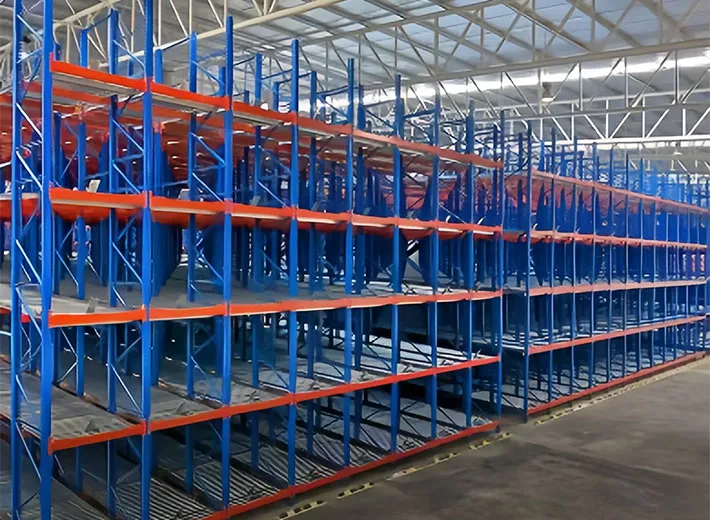
Poor storage planning wastes floor space, slows picking, and increases product damage. The…
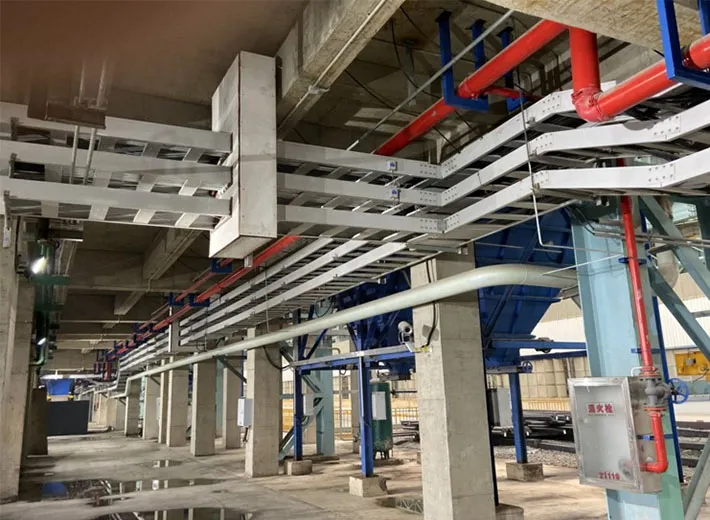
Loose electrical lines create blocked access, poor airflow, slow maintenance, and higher d…
Le responderemos en un plazo de 24 horas. Si para el caso urgente, por favor agregue WhatsApp/WeChat: +8613863639320,. O llame directamente a +8613863639320.
*Respetamos su confidencialidad y toda la información está protegida.
Sólo utilizaremos sus datos para responder a su consulta y nunca le enviaremos correos electrónicos o mensajes promocionales no solicitados.