


Azienda
18 November 2026
Temporary Power Distribution Boxes: Uses and Sourcing Guide
A temporary power distribution box is a portable enclosure that takes one incoming supply …
 09:14
Chenlong Technical Team | Corporate Technical Author, Weifang Chenlong Intelligent Technology Co., Ltd. | Published: October 28, 2026
A portable metal stud machine is a compact roll former that a framing crew moves to the job site to form studs and tracks from coil on demand. A metal stud production line is a factory installation that combines decoiling, feeding, punching, forming and cutting for continuous output of framing profiles.
Both machines bend coil into the same basic C- and U-shaped profiles. The difference is in who runs them, where, and for how many buildings.
“Portable stud machine” covers two unrelated products in search results. One is the portable stud welder, a hand-held tool that welds threaded or pinned fasteners onto a metal surface. It has nothing to do with wall framing. The other is the job-site stud former, which is what framing contractors mean.
A job-site stud former is sized to travel on a trailer or truck and run near the building it supplies. As one example, Roofing Contractor magazine described a portable stud forming machine that can produce studs or track in four widths (2½, 3½, 5½ and 6 inches), switching sizes with quick-change shear cassettes, and forming a standard C-shaped profile that meets American Iron & Steel Institute design standards and U.S. residential building codes. The same machine came with a programmable cut controller, adjustable decoiler, automatic oiler, hydraulic shear and flying punch as standard.
The design aim is clear from that list. A crew cuts studs to exact length on site, from one coil, without waiting for a delivery.
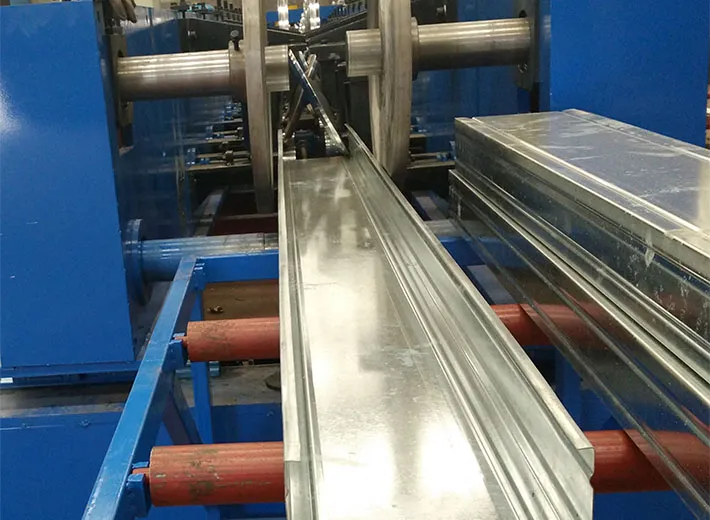
A production line sits at the other end. It runs in a fixed workshop with coil storage, power supply, trained operators and space for finished bundles. The finished profiles ship to many job sites rather than one.
Chenlong’s Automatic Production Line for Light Steel Keels and Keel Roll Forming is a factory line of this type. Here is what the company publishes about it:
| Articolo | Published information |
| Applications | Light steel framing, partition walls, suspended ceilings, building framing profiles, custom construction profiles |
| Supported materials | Cold-rolled steel, hot-rolled steel, galvanized steel, stainless steel, pre-coated steel, aluminum alloy, copper and high-strength sheet, depending on project configuration |
| Line functions available | Decoiling, leveling, feeding, punching, roll forming, cutting, bending, welding, collecting/stacking and packaging, integrated according to project requirements |
| Material width, thickness, speed | Not published for this line; configured per project |
| Engineering basis | Customer drawings, samples, materials, dimensions, punching requirements and production targets |
| Tempi di consegna | Standard equipment 20–30 business days; custom equipment 40–60 business days |
| Payment terms | T/T or L/C; 30% down payment on order confirmation, balance after inspection and before shipment |
| Pricing | Quoted project by project; no public price list |
The width, thickness and speed figures for this line are not on the product page. We do not borrow the ranges published for Chenlong’s other lines, because a keel line is configured differently from, say, a racking or cable tray line. Ask for these figures in the quotation for your profile drawings.
Compared with typical job-site portable stud formers, a factory production line trades mobility for profile range and continuous output.
| Factor | Job-site portable stud former | Factory production line |
| Where it runs | At or near the building being framed | Fixed workshop |
| Who operates it | The framing crew | Dedicated line operators |
| Profile range | A small set of stud and track sizes, changed by cassettes or adjustment | Built around your profile drawings; can cover studs, tracks, ceiling keels and custom framing profiles depending on configuration |
| Upstream/downstream processes | Basic decoiling, cutting and punching on board | Can add leveling, servo feeding, inline punching, stacking and packaging |
| How output is used | Cut-to-length parts for the current job | Inventory and orders for many projects and customers |
| Logistics | Moves coil to site; no long-profile shipping | Ships finished bundles to sites |
| Purchase basis | Usually a catalog model | Engineered and quoted per project |
Buyers searching for a portable machine sometimes want something else entirely. These are the cases we see most often.
You plan to supply other contractors. A portable former is built to feed one crew. If the business model is selling framing profiles to distributors or builders, output, profile range and stacking matter more than mobility, and a production line is the relevant category.
You need ceiling keels as well as wall studs. Suspended-ceiling systems use main and cross keels with their own profiles and punching. A machine sized for a few stud widths may not cover them.
“Transportable” is being read as “portable.” A factory line can be shipped in containers to a new workshop and installed there. That makes it relocatable, not job-site portable. It still needs a foundation area, coil handling and a stable power supply.
The site has no reliable power or coil storage. Portability does not remove the need to keep coil dry and power stable. On remote sites, delivering pre-formed profiles from a factory can be simpler.
Portable formers remove delivery waits and cut waste from fixed-length stock, since parts are cut to the length needed. They are limited by their profile set. Their output also depends on the same crew that is framing the building, so forming time competes with installation time.
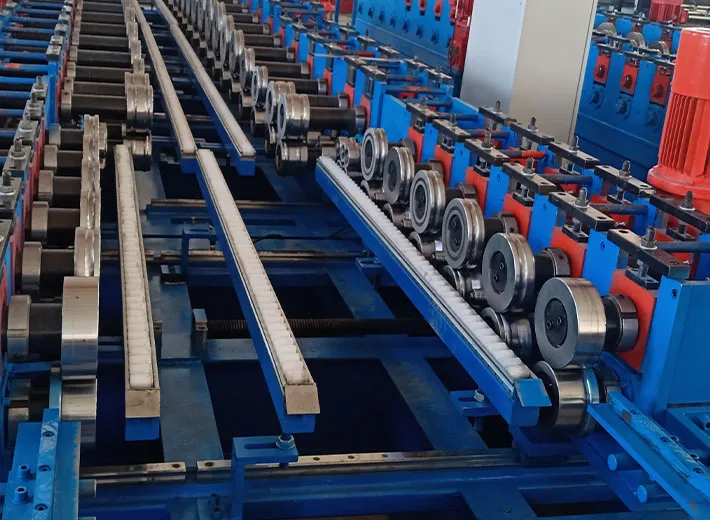
Production lines cover a wider profile range and add processes such as inline punching and stacking. The costs are real ones: a workshop, coil logistics, trained operators, and a 40–60 business day lead time for custom equipment before the first profile runs. Finished long profiles also have to be transported, which a site-based former avoids.
Q: Does Chenlong make job-site portable stud machines?
A: Chenlong’s published product range covers factory-based automated production lines, including its light steel keel line, rather than job-site portable stud formers.
Q: Can a light steel keel line produce wall studs and tracks?
A: The line is published for light steel framing, partition walls and suspended ceilings. The exact profiles depend on the configuration, so send your stud and track drawings for confirmation.
Q: How much does a metal stud production line cost?
A: Chenlong quotes each line individually, based on profile drawings, materials, speed, punching and automation level. There is no public price list. Payment is by T/T or L/C, with a 30% down payment on order confirmation.
Q: How long does delivery take?
A: Chenlong’s published lead times are 20–30 business days for standard equipment and 40–60 business days for custom equipment. Expedited production may be available for urgent orders.
Q: Is a portable stud welder the same as a portable stud machine?
A: No. A stud welder attaches fasteners to metal surfaces. Stud forming machines roll coil into framing studs and tracks.
Q: Which materials can the keel line process?
A: Published options include cold-rolled, hot-rolled, galvanized, stainless, pre-coated and high-strength steel, plus aluminum alloy and copper, depending on project configuration.
A temporary power distribution box is a portable enclosure that takes one incoming supply …
Seven electrical panel board types explained for cabinet and switchgear manufacturers, plu…
Ti risponderemo entro 24 ore. In caso di emergenza, aggiungi WhatsApp/WeChat: +8613863639320,. Oppure chiama direttamente +8613863639320.
*Rispettiamo la tua riservatezza e tutte le informazioni sono protette.
Utilizzeremo le tue informazioni solo per rispondere alla tua richiesta e non invieremo mai email non richieste o messaggi promozionali.