











Empresa
20 September 2026
Warehouse Racking Systems & Shelving Production Guide
Moving a warehouse shelving line from standard to custom profiles changes four things: too…
 16:06
16:06 EV charger brands need more than a good circuit design. If the enclosure leaks, bends, overheats, or looks weak, the whole charger can fail in the field. A better enclosure manufacturing process protects the charger and helps your business grow.
En EV charger enclosure is the protective box or cabinet that houses the charger’s internal components, cable system, control unit, and user interface. For outdoor EV charger projects, a strong enclosure improves weather resistance, safety, installation speed, durability, and long-term performance for residential, commercial, and public electric vehicle charging applications.
An EV charger enclosure is the outer protective structure of an EV charger. It may look simple from the outside, but it carries a big job. It protects electrical components, charging components, the charging cable entry, communication modules, display screens, switches, and control boards.
For an electric vehicle user, the enclosure is also the first thing they see. A clean and high-quality enclosure makes the charger look safe and professional. A poor enclosure gives the opposite feeling. It may suggest poor durability, weak sealing, or unstable production.
In simple words, the enclosure is the body of the charger. The electronics are the brain. The cable is the arm. All parts must work together to create a safe and smooth charging experience.
An outdoor EV charger enclosure must handle rain, dust, heat, sunlight, wind, and daily use. In public parking lots, the enclosure may also face bumps, vandalism, tamper attempts, and rough handling. This is why outdoor design is harder than indoor design.
A weak enclosure may cause several problems:
For EV charging station operators, this is not a small issue. Poor charger reliability can hurt the whole charging network. When drivers cannot use a charger, they do not blame only the cabinet. They blame the brand, the site owner, and the charging infrastructure.
That is why buyers should not treat the enclosure as “just a box.” A good enclosure helps safeguard the charger, protect users, and reduce long-term service costs.
EV charger enclosure manufacturing usually starts with product design and ends with inspection. The process may include material selection, laser cutting, punching, bending, cold forming, welding, polishing, coating, assembly, and testing.
A typical process looks like this:
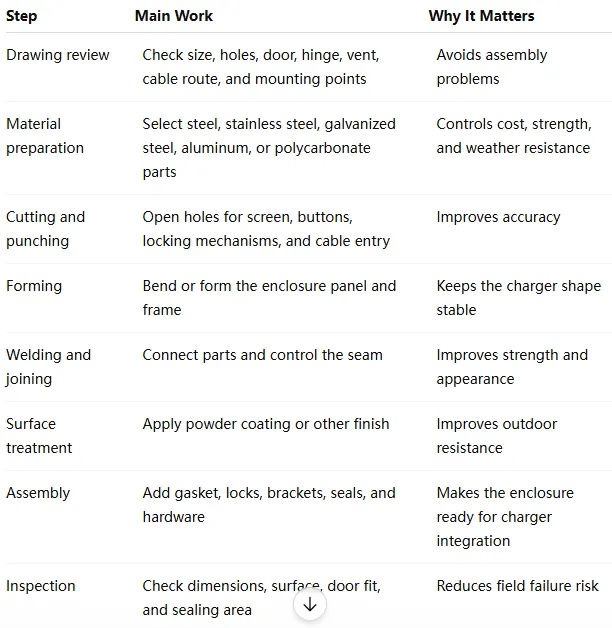
The manufacturing process should match the charger type. A small wall-mounted charger may use compact enclosures. A DC fast charger may need a stronger ev charger cabinet with more space, cooling, and service access.
For OEM buyers, repeatability is key. One good sample is not enough. You need the same enclosure quality again and again.
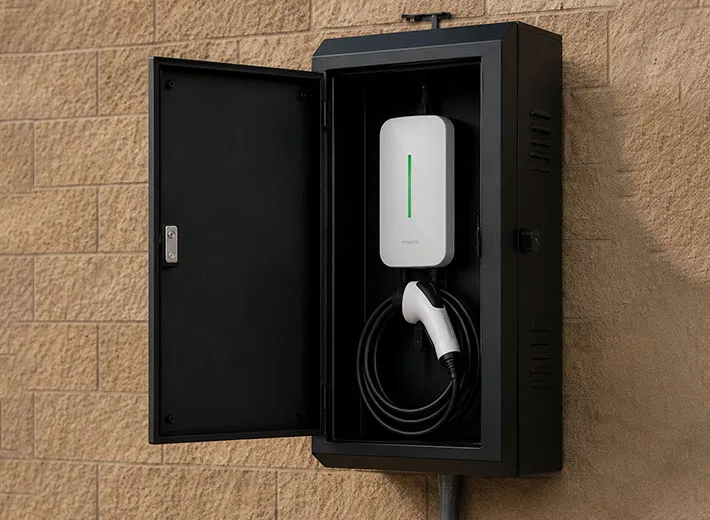
Customization helps the enclosure match the charger brand, market, and installation environment. It is not only about color. It is about function, fit, and production efficiency.
Common customization options include:
A fully customized enclosure can support a better charging solution. It can make installation easier, service faster, and the product more attractive to distributors and end users.
For an original equipment manufacturer, customization is often needed because each charger design is different. The circuit layout, cable system, screen position, and internal components may not match standard boxes. In this case, designed enclosures are better than generic cabinets.
At Chenlong, we understand this from the production side. When customers bring drawings, we do not only look at the final shape. We also check whether the enclosure can be formed, assembled, coated, and produced in batches with stable quality.
Installation affects the enclosure from the first day of use. A good charger design must match the site. If the installation method is wrong, even a strong enclosure may perform poorly.
Common installation methods include:
Each method changes the load on the enclosure. A wall-mounted charger needs strong rear mounting points. A pole-mounted charger must control vibration. A public charging station must handle user movement, cable pulling, and possible impact.
Configuration also matters. The internal configuration should leave enough room for electrical components, wiring, charging cable management, and heat flow. If parts are packed too tightly, service becomes harder and heat may build up.
A simple rule works well: make the enclosure easy to install, easy to open, easy to service, and hard to damage.
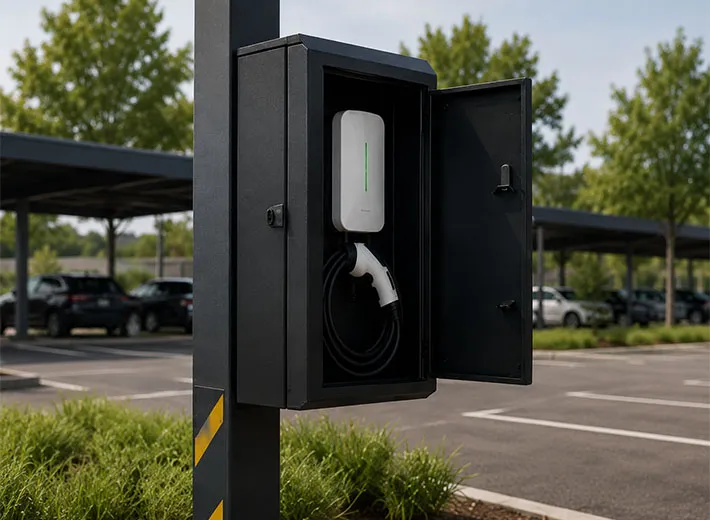
Installation affects the enclosure from the first day of use. A good charger design must match the site. If the installation method is wrong, even a strong enclosure may perform poorly.
Common installation methods include:
Each method changes the load on the enclosure. A wall-mounted charger needs strong rear mounting points. A pole-mounted charger must control vibration. A public charging station must handle user movement, cable pulling, and possible impact.
Configuration also matters. The internal configuration should leave enough room for electrical components, wiring, charging cable management, and heat flow. If parts are packed too tightly, service becomes harder and heat may build up.
A simple rule works well: make the enclosure easy to install, easy to open, easy to service, and hard to damage.
Weifang Chenlong Intelligent Technology Co., Ltd. is a high-tech company based in Shandong, China. We focus on high-precision cold bending forming equipment and customized automated production lines. Our solutions support metal profile processing for industries such as electrical equipment, new energy, and structural equipment.
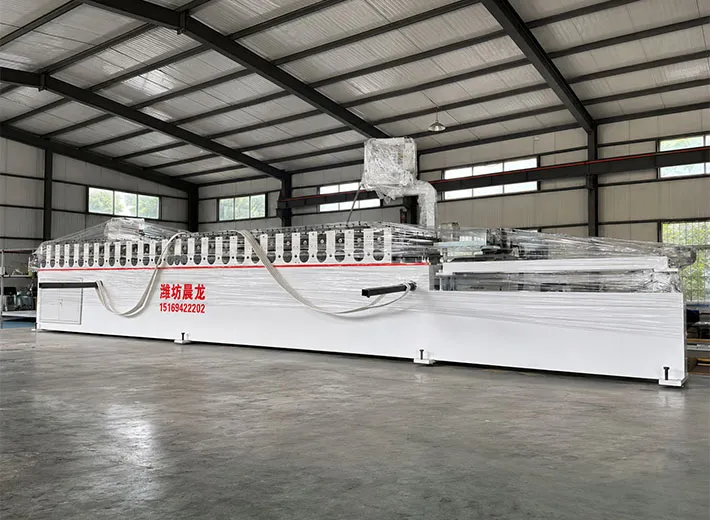
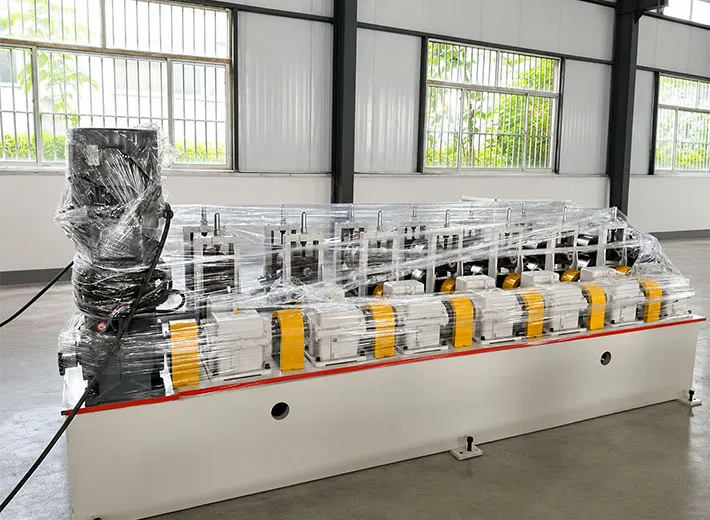
For EV charger enclosure manufacturing, Chenlong can help manufacturers, distributors, and OEM partners improve the way they produce enclosure parts, cabinet frames, mounting profiles, support rails, and related metal structures.
As an enclosure manufacturer in China may focus on finished cabinets, Chenlong focuses more on the production system behind the cabinet. We help customers build the line that can manufacture enclosures with higher speed, better accuracy, and lower labor cost.
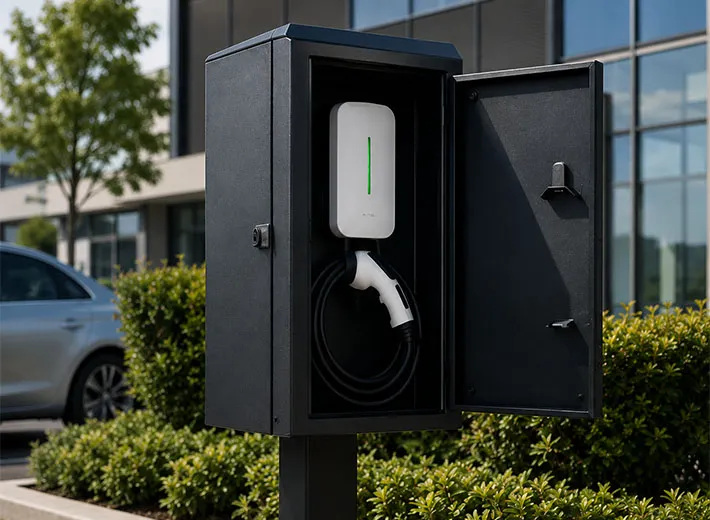
Before investing in enclosure production equipment, OEM buyers should check both the charger design and the factory plan. The goal is not only to buy a machine. The goal is to create a stable production system.
Use this simple checklist:
A professional supplier should ask these questions before offering a solution. If a supplier only gives a price, be careful. A low price does not always mean low cost. Poor equipment can create downtime, scrap, and delivery problems.
Chenlong studies the whole process before recommending equipment. That is how we help customers reduce risk and build better production capacity.
En EV charger enclosure is the outer box, cabinet, or housing that protects the charger’s internal components, wiring, cable entry, control system, and user interface. It helps protect the charger from dust, rain, impact, heat, and daily use.
An EV charger box is usually smaller and often used for compact or wall-mounted chargers. An EV charger cabinet is usually larger and may be used for commercial chargers, DC fast chargers, or public charging station systems.
An outdoor EV charger enclosure protects the charger from weather, UV, dust, moisture, tamper risk, and impact. It also supports safe installation, cable management, and long-term charger durability.
Not always. IP65 is a common target for outdoor electrical products, but the final requirement depends on the market, charger design, local rules, and installation site. The full charger system should be tested according to the target standard.
Sí. EV charger enclosures can be customized by size, material, color, vent layout, cable entry, lock type, mounting method, internal brackets, and logo area. OEM buyers often need custom designs to match their charger structure.
Chenlong mainly provides high-precision cold bending forming equipment and customized automated production lines. We help charger manufacturers, enclosure producers, distributors, and OEM partners improve enclosure and metal profile production.
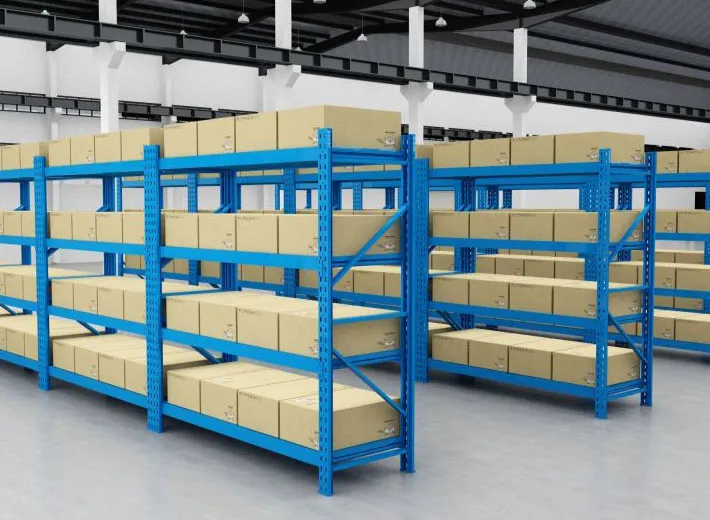
Moving a warehouse shelving line from standard to custom profiles changes four things: too…
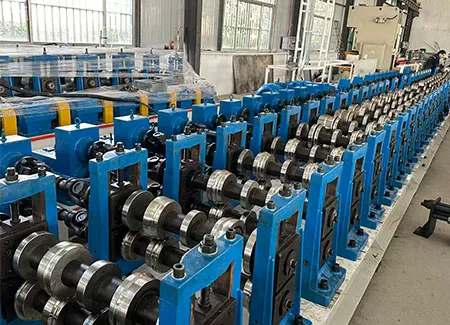
Chenlong’s roof and wall panel line is a factory-based automated roll forming system…
Le responderemos en un plazo de 24 horas. Si para el caso urgente, por favor agregue WhatsApp/WeChat: +8613863639320,. O llame directamente a +8613863639320.
*Respetamos su confidencialidad y toda la información está protegida.
Sólo utilizaremos sus datos para responder a su consulta y nunca le enviaremos correos electrónicos o mensajes promocionales no solicitados.