











Unternehmen
02 September 2026
Warehouse Racking Systems and Warehouse Shelving: How to Choose the Right Storage Solution
Poor storage planning wastes floor space, slows picking, and increases product damage. The…
 10:32
10:32 Poor storage planning wastes floor space, slows picking, and increases product damage. The problem becomes worse as inventory grows. Choosing suitable warehouse racking systems, shelving profiles, and layouts helps manufacturers and warehouse operators create safer, more efficient storage without unnecessary expansion.
Warehouse shelving should be selected according to product weight, dimensions, access frequency, handling equipment, building height, and future capacity. Palletized goods usually require engineered pallet racks, while cartons, tools, components, and retail products may suit adjustable steel shelving or light- and medium-duty shelving systems.
Warehouse racking systems are structural storage arrangements designed to hold pallets, cartons, components, sheet materials, tools, or other goods in organized vertical levels. A complete system may include upright frames, beams, braces, shelf panels, connectors, base plates, anchors, and protective accessories.
The correct system depends on more than storage volume. Buyers must consider:
A system used for hand-loaded cartons differs from heavy duty pallet racks operated by forklifts. The components may look similar, but their structural requirements, connection designs, load ratings, and installation methods are different.
At Weifang Chenlong Intelligent Technology Co., Ltd., we focus on the manufacturing side of these systems. We provide cold-formed steel profiles and customized roll-forming equipment for shelving and racking manufacturers. Buyers can explore our complete range of warehousing field profiles and production equipment.
Warehouse shelving normally supports cartons, bins, tools, packaged goods, and individual components loaded by hand. Pallet racking supports palletized loads handled by forklifts, reach trucks, or other material-handling equipment.
| Factor | Warehouse Shelving | Pallet Racking |
| Typical Goods | Cartons, tools, and small parts | Palletized products |
| Loading Method | Manual loading | Forklift or reach truck |
| Common Components | Posts, shelves, and braces | Uprights, beams, and anchors |
| Typical Duty | Light to medium | Medium to heavy |
| Access | Direct hand access | Equipment-assisted access |
| Main Design Concern | Shelf capacity and ergonomics | Pallet load, beam level, and impact risk |
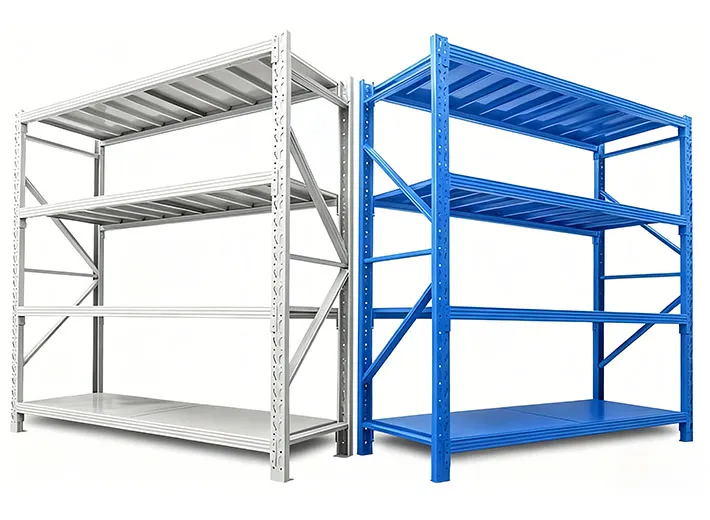
Warehouse shelving units may use solid steel panels, perforated shelves, wire decks, or laminated shelf profiles. Adjustable levels make the system easier to adapt when carton dimensions or product ranges change.
Pallet systems use engineered uprights and beams. The upright profile, slot pattern, brace arrangement, connector, steel thickness, and beam section all affect system performance. Components that appear compatible should not be mixed without technical verification.
No single shelf type suits every product. A practical warehouse often combines several systems.
| Storage Requirement | Suitable System | Main Advantage |
| Small cartons and spare parts | Adjustable steel shelving | Easy manual access |
| Palletized inventory | Selective pallet rack | Direct access to each pallet |
| Fast-moving cartons | Carton flow rack | Supports first-in, first-out picking |
| Long pipes or profiles | Cantilever rack | Open-front storage |
| High-volume reserve stock | Bulk storage racks | Efficient use of larger storage zones |
| Retail and grocery products | Supermarket shelving | Flexible display and replenishment |
| Sheet metal | Horizontal sheet metal storage racks | Separates and supports flat material |
| Records and low-access inventory | Mobile shelving | Reduces the number of fixed aisles |
Industrial wall shelving may help organize tools and light components near production stations, but wall structure and fixing capacity must be checked before installation.
For light and medium loads, roll-formed shelf panels provide a stable, repeatable surface. Chenlong supplies roll-formed steel shelf laminate profiles designed around customer drawings, materials, dimensions, and production requirements.
A good warehouse racking layout begins with product and process data, not with the number of racks that can fit on a drawing.
Start by recording:
Fast-moving goods should usually stay closer to receiving, production, packing, or dispatch areas. Slow-moving reserve stock can occupy higher or more distant locations. Heavy products normally belong at lower levels unless an engineered design states otherwise.
A layout that fills every open area is not automatically efficient. Narrow aisles may increase density but reduce visibility and require specialized lift equipment. Wide aisles improve movement but consume more floor space. The correct balance depends on throughput, selectivity, safety, and equipment.
Do not block emergency exits, electrical panels, fire equipment, pedestrian routes, or required clearances. OSHA states that stored material must remain stable and secure against sliding or collapse, and storage areas must remain free from hazardous accumulations. Project teams should review the applicable requirements in OSHA 1910.176.
Heavy duty warehouse shelving is appropriate when loads exceed the practical capacity of ordinary hand-loaded shelves or when the stored goods create high concentrated loads.
Typical applications include:
Do not judge capacity from the appearance of a shelf. Buyers need the rated capacity of the complete bay, not only the shelf panel or beam. Uprights, beams, braces, connectors, footplates, anchors, decking, and floor conditions work together.
The term “heavy duty” is often used in advertising without a common load definition. Before ordering, request documented information covering:
For U.S. industrial projects, ANSI MH16.1 addresses the design, testing, and use of industrial steel storage racks. The Rack Manufacturers Institute also identifies separate guidance for cantilever racks and industrial rack decking.
Searches for warehouse shelving for sale, buy warehouse shelving, or warehouse shelving sale often produce systems with very different materials, capacities, and quality levels. Comparing price alone can hide important differences.
Before purchasing, prepare a specification sheet containing:
A low quotation may exclude anchors, bracing, decking, end guards, row spacers, load signs, or installation. These items can change the final project cost.
The same rule applies when comparing price warehouse shelving results online. A unit price has little value unless the quotation defines load, dimensions, material, finish, quantity, packaging, and destination.
A pallet racking cost calculator can provide an early budget estimate, but it cannot replace engineering review. Floor condition, building height, seismic requirements, forklift access, local regulations, accessories, freight, and installation can materially change the total cost.
Standard products work well when dimensions, load levels, and operating methods are common. Custom warehouse shelving becomes valuable when the buyer needs special widths, profile sections, hole patterns, load levels, finishes, or integration with existing systems.
Customization may be suitable for:
A small warehouse may need small warehouse shelving that maximizes vertical space without blocking work areas. A large distribution center may need several rack types arranged around automated handling, picking, and replenishment processes.
For shelving manufacturers, customization begins with the steel profile. Slot position, hole pitch, formed angle, straightness, cut length, and connector geometry determine whether the parts assemble correctly.
Chenlong’s roll-formed steel profiles for warehouse shelving and industrial racking can be developed according to customer drawings and samples. These products can include uprights, beams, shelf components, supports, brackets, and other custom cold-formed sections.
Material selection depends on load, manufacturing process, environment, target service life, and budget.
| Material or Finish | Typical Use | Main Consideration |
| Kaltgewalzt-Stahl | Indoor shelving and accurate profiles | Good dimensional control |
| Hot-rolled steel | Heavier industrial components | Surface and tolerance requirements |
| Verzinkter Stahl | Humid or corrosion-prone locations | Zinc coating and formed-edge protection |
| Edelstahl | Food, clean, or corrosive environments | Higher cost and different forming behavior |
| Pre-coated steel | Retail and finished shelf panels | Protecting the coating during forming |
| Powder-coated steel | General indoor warehouse use | Surface preparation and coating quality |
Corrosion resistance should match the actual environment. Humidity, condensation, chemicals, salt, cleaning methods, and temperature can all affect performance.
The selected material also affects the production line. Roller design, punching dies, forming passes, lubrication, cut-off method, and working speed may need adjustment for different steel grades and thicknesses.
Cold roll forming shapes a continuous strip of metal through a series of roller stations. Each station makes a controlled bend until the required profile is complete.
A typical production flow includes:
This method suits long components with a consistent cross-section, including rack uprights, beams, braces, shelf edges, and support channels.
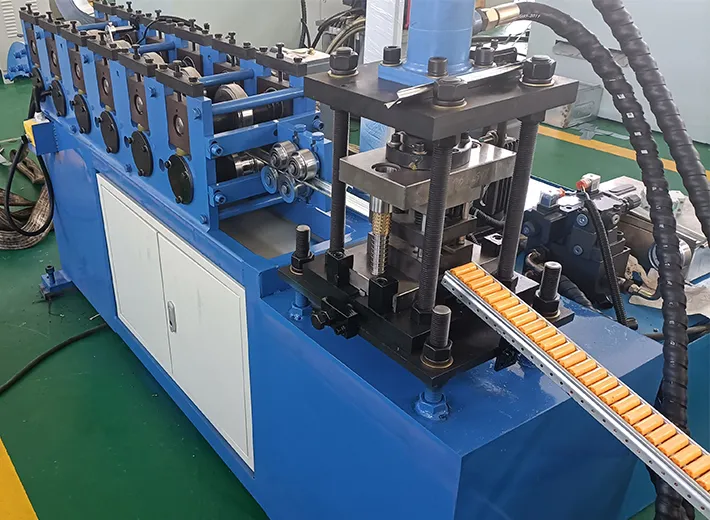
Accurate punching is especially important. If upright slots move out of position, beam levels may not align. If hole spacing changes between batches, replacement components may not fit. Stable feeding and synchronized punching help manufacturers maintain repeatable dimensions.
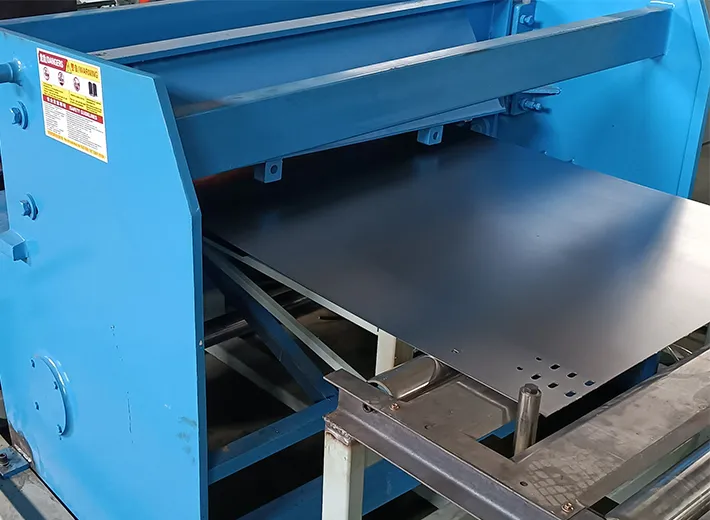
Chenlong’s automatic production line for warehouse and supermarket shelving integrates loading, leveling, feeding, punching, roll forming, cutting, and receiving functions according to the required configuration.
Traditional manufacturing may separate punching, bending, cutting, handling, and inspection into several operations. Every transfer adds labor, waiting time, work-in-process inventory, and another opportunity for dimensional error.
An integrated line can provide:
Automation level should match the factory’s real order volume. A highly automated line may suit stable, high-volume production. A more flexible line may be better for frequent size changes and smaller batches.
Chenlong reviews the finished product before recommending the equipment. Important inputs include:
Our warehouse light-duty racking solution connects profile development, punching, roll forming, cutting, and shelving application requirements.
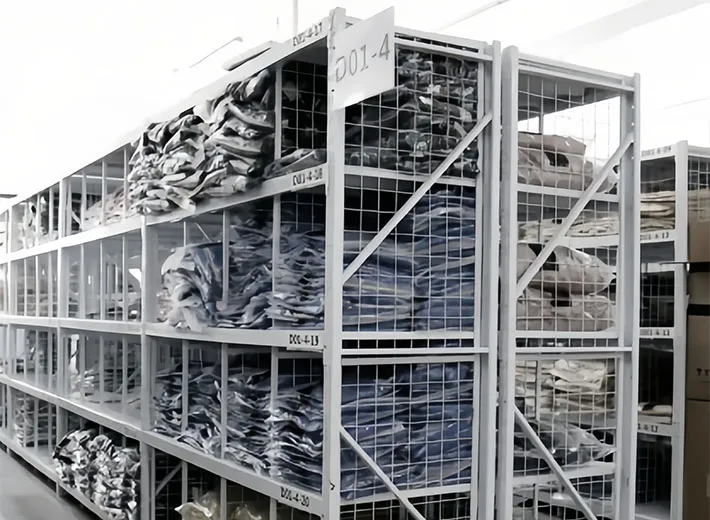
Supermarket shelving combines storage, display, replenishment, appearance, and customer access. The parts must remain strong, but surface consistency and visual quality are also important.
A typical supermarket system may include:
Retail shelves often need frequent height adjustment because product sizes change. Accurate upright slots and bracket connections help store operators reconfigure displays without replacing the complete system.
Chenlong’s cold-formed steel profiles for supermarket shelving systems support rack uprights and shelving components with optional punching and slotting functions.
Quality control should begin with raw material verification and continue through punching, forming, cutting, and trial assembly.
Important checks include:
Manufacturers should also test representative components and complete assemblies according to the applicable product and market requirements. A profile that looks correct may still fail to fit, carry the intended load, or remain stable after assembly.
For repeat production, keep approved drawings, tooling records, control parameters, inspection plans, and reference samples. This reduces setup time and helps factories maintain consistent output across future orders.
To prepare a practical proposal, send us:
Weifang Chenlong Intelligent Technology Co., Ltd. provides high-precision cold bending forming equipment, customized automated production lines, and cold-formed profiles for global manufacturers, distributors, and OEM partners.
We do not treat every shelving factory the same. A supplier making light retail shelves has different production needs from a manufacturer producing industrial rack uprights. We review the product family, manufacturing process, output target, and changeover requirements before developing the solution.
Contact Chenlong with your drawings or samples. Our team will evaluate the profile, recommend the necessary production stages, and prepare a customized equipment or profile solution.
Racking normally supports palletized goods handled by forklifts, while shelving commonly holds cartons, bins, tools, and individual products loaded by hand. Their structural designs, capacities, and handling methods differ.
Multiply the maximum weight of each stored item by the maximum quantity placed on one level, then account for the load distribution. Use the manufacturer’s documented shelf and bay ratings and obtain engineering review for industrial applications.
A customized line may support several widths, heights, hole patterns, or cut lengths through adjustable stations, programmed feeding, replaceable dies, or tooling changes. The practical range depends on the profile design and material.
You need the product size, load, number of units, handling method, shelf access, available floor area, building height, and required clearances. A layout should also include future inventory growth.
No. They work best for larger quantities or reserve inventory. Fast-moving products may need more selective storage so workers can access each SKU without unnecessary handling.
Chenlong mainly supplies customized cold-formed steel profiles and automatic production equipment for shelving and racking manufacturers. Project scope should be confirmed from drawings, components, production targets, and application requirements.
Efficient storage begins with the correct layout, load data, shelving type, and handling method. Reliable manufacturing begins one step earlier—with accurate profiles, repeatable punching, stable forming, and consistent cutting.
Whether you need shelf panels, rack uprights, custom profiles, or a complete automated line, Chenlong can develop a manufacturing solution around your products and target capacity.
Send us your drawings, samples, material specifications, and output requirements. We will help you turn your shelving design into a stable and scalable production process.
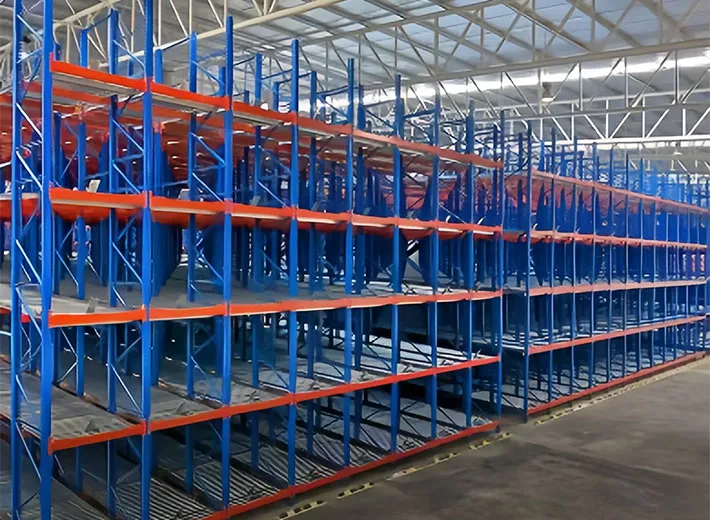
Poor storage planning wastes floor space, slows picking, and increases product damage. The…
Loose electrical lines create blocked access, poor airflow, slow maintenance, and higher d…
Wir werden Ihnen innerhalb von 24 Stunden antworten. Bei dringenden Angelegenheiten fügen Sie bitte WhatsApp/WeChat hinzu: +8613863639320 oder rufen Sie direkt +8613863639320 an.
*Wir respektieren Ihre Vertraulichkeit und alle Informationen sind geschützt.
Wir verwenden Ihre Informationen ausschließlich zur Beantwortung Ihrer Anfrage und senden niemals unerwünschte E-Mails oder Werbenachrichten.