











Şirket
20 September 2026
Warehouse Racking Systems & Shelving Production Guide
Moving a warehouse shelving line from standard to custom profiles changes four things: too…
 14:31
14:31 Plan a custom warehouse racking and shelving production line. Compare profiles, materials, layout, tooling, lead time and project quotation factors.
Warehouse racking systems are not one-size-fits-all products. A small parts store, a distribution center and a metal service warehouse may all require different upright profiles, beam sections, shelf panels, hole patterns and load configurations. These differences directly affect how the shelving components must be manufactured.
For companies that want to produce warehouse shelving, pallet racks or commercial storage systems in-house, the main question is not simply which rack looks suitable. Buyers must translate the required finished product into a workable production specification: profile drawings, material grade, coil width, thickness, punching pattern, forming speed, voltage and automation level.
This guide explains how a standard warehouse and supermarket shelving line can be configured for different racking products. It also clarifies the difference between buying finished warehouse shelving for sale and investing in equipment that manufactures the uprights, beams and panels used in those systems.
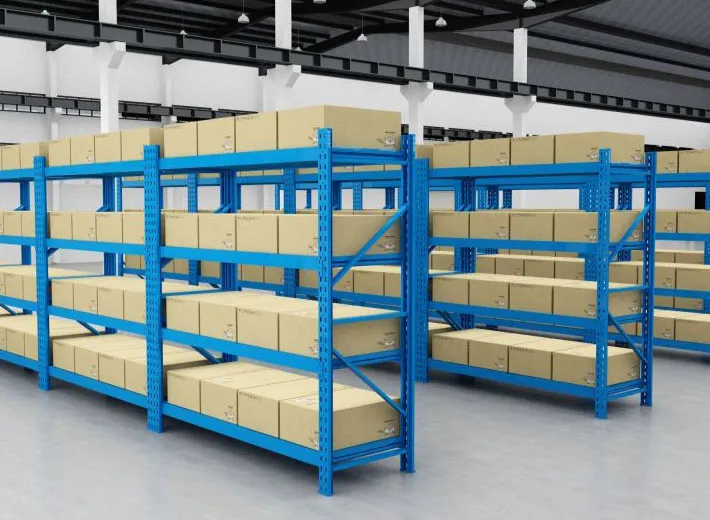
Most warehouse racking and shelving products are assembled from several formed metal components. The exact structure varies, but a typical system may include:
Uprights and beams that form the main load-bearing frame;
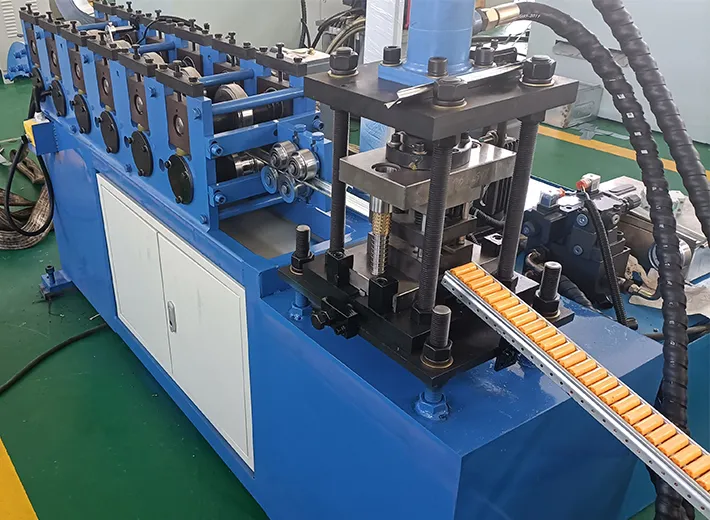
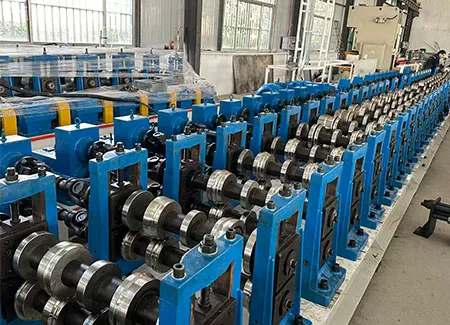
The production sequence generally remains the same: decoiling, leveling, servo feeding, punching, roll forming and cutting. However, the tooling and calibration must match the required cross-section and hole pitch.
Chenlong’s published operating envelope for its warehouse and supermarket shelving line covers raw material widths of 10–2,000 mm, rolling thicknesses of 0.2–10 mm and forming speeds of 0–50 m/min. Applicable materials include SPCC, SPHC, SGCC, SUS, aluminum and SECC. A custom project must remain inside this technical envelope; a profile outside it may require a different machine class rather than a tooling adjustment.
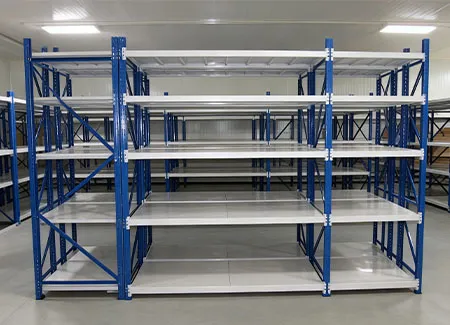
| Storage Application | Typical Product Requirement | Production Detail to Confirm |
| Heavy Duty Pallet Racks | Strong upright and beam profiles for palletized loads | Material grade, thickness, cross-section, connector design, and punching pitch |
| Heavy Duty Warehouse Shelving | Reinforced frames and shelf panels | Profile dimensions, shelf width, bend geometry, and load target |
| Bulk Storage Racks | Large storage bays for cartons, components, or bulk goods | Bay size, beam profile, shelf or deck design, and bracing arrangement |
| Warehouse Shelving Units | Modular, adjustable storage sections | Slot pattern, upright profile, shelf-panel design, and repeatability |
| Bin Shelving System in Warehouse | Multiple storage positions for small-parts bins | Shelf spacing, divider or bin-support details, and punching accuracy |
| Small Warehouse Shelving | Compact bays for spare parts, tools, or cartons | Narrower profiles, panel dimensions, and flexible hole spacing |
| Large Warehouse Shelving | Wider or taller storage structures | Wider panels, stronger profiles, and project-specific handling requirements |
| Industrial Wall Shelving | Wall-supported storage for tools or components | Bracket profile, fixing-hole pattern, and shelf-panel geometry |
| Heavy Duty Commercial Shelves | Durable storage for stockrooms and wholesale facilities | Surface dimensions, reinforcement, and required production volume |
| Commercial Shelves with Wheels | Mobile shelving or commercial storage carts | Base-frame and wheel-interface profiles; wheel assemblies are separate components |
| Horizontal Sheet Metal Storage Racks | Horizontal bays for sheet stock | Long supporting profiles, section strength, and rack geometry |
| Vertical Carton Storage Stand | Vertical divided storage for cartons or flat products | Divider spacing, frame profile, and connection details |
This table describes the manufacturing questions associated with each product concept; it does not claim that one standard line automatically produces every finished system. Final feasibility must be checked against the buyer’s drawings, materials and required component dimensions.
A warehouse racking layout is more than a drawing of rack rows. It determines how many bays, uprights, beams and shelves the project needs and therefore affects the production volume and tooling plan.
Before requesting a machine quotation, define the following:
For buyers researching dimensions warehouse shelving, finished rack dimensions alone are not enough for equipment selection. The machine manufacturer also needs dimensioned drawings of the individual profiles. A rack may be described by its overall height, width and depth, while the forming line must be designed around the precise geometry of every upright, beam and panel it will produce.
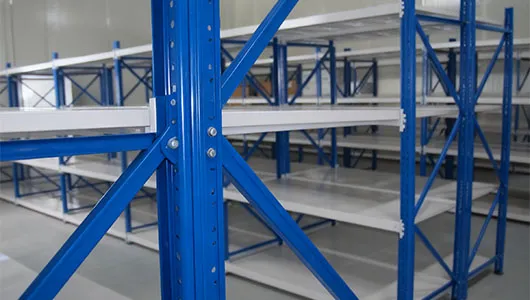
A standard racking line is built around a fixed set of profiles, such as an upright, a beam and a deck panel. The tooling is already designed for those sections. A custom project asks the same basic production process to manufacture a new cross-section or punching pattern.
Custom work may be required for:
When buyers use the phrase custom warehouse shelving, they may mean either a finished shelving system built to special dimensions or equipment configured to make custom shelving components. Chenlong’s role is in the second category: designing and manufacturing the roll forming equipment and tooling used to produce the profiles.
Moving from a standard profile to a custom profile is not a paperwork-only change. It normally involves four production tasks:
Changing only the punching die is insufficient when the new product also changes the bend geometry or roll stand setup. If feeder positioning and forming-tool alignment are not verified, possible downstream issues include inaccurate hole spacing, flange distortion, punch-edge burrs or dimensional drift.
Tooling changes should also be included in the buyer’s own machinery safety review. ISO 12100 provides general principles for machinery risk assessment and hazard identification. It is a useful reference for the integrator’s safety process, but it should not be interpreted as a certification claim for a specific machine unless supporting certification documents are supplied.
| Parameter | Published Range or Option |
| Applicable Materials | SPCC, SPHC, SGCC, SUS, aluminum, and SECC |
| Raw Material Width | 10–2,000 mm |
| Rolling Thickness | 0.2–10 mm |
| Forming Speed | 0–50 m/min |
| Punching Die Materials | Cr12MoV, SKD11, or DC53, selected according to the material and application |
| Servo Besleyici | Yaskawa, Delta, or customized configuration |
| Motor Power | 3–200 kW, depending on the configuration |
| Gerilim | 110–380 V, customized to the local power supply |
These figures apply to Chenlong’s warehouse and supermarket shelving line. They should not be treated as universal specifications for every roll forming machine or as confirmation that any profile within the numerical range is automatically feasible. The final configuration depends on the drawing and production target.
For projects in Southeast Asia, Central Asia and Africa, buyers should provide installation-site data instead of relying on a generic regional configuration.
Confirm the following before manufacturing begins:
Chenlong publishes a voltage customization range of 110–380 V and lists optional on-site installation and training for warehousing solutions. The final service scope should be written into the quotation and contract.
The published motor-power range is 3–200 kW, while voltage can be configured from 110 to 380 V according to the local supply. The final selection depends on the line arrangement and target profiles. Additional punching operations, thicker material, wider profiles or a higher level of automation can increase the power requirement.
The upper end of the published range is not the default for every shelving line. Likewise, voltage customization does not eliminate the buyer’s responsibility to provide accurate site information. Confirm voltage, frequency and phase requirements before manufacturing begins; a mismatch can delay installation even when the forming equipment itself is complete.
Searches such as price warehouse shelving, warehouse shelving sale, buy warehouse shelving and pallet racking cost calculator usually refer to finished racks. A finished shelving quotation may be based on bay quantity, rack dimensions, load level, material, coating, accessories, installation and freight.
A production-line quotation is calculated differently. It depends on factors such as:
For this reason, a finished-rack pallet racking cost calculator cannot estimate the cost of manufacturing equipment. Chenlong does not publish a single price for a custom shelving line because the machine must be quoted against the actual profile drawings and production requirements.
The disclosed commercial terms are a 30% down payment at order confirmation, with T/T or L/C accepted, and the balance paid after inspection and before shipment. Standard equipment has a published lead time of 20–30 business days; custom equipment requires approximately 40–60 business days. Expedited production may be available for urgent projects and should be confirmed in the quotation.
No public minimum order quantity is stated. Buyers should request project-specific terms rather than relying on an assumed MOQ.
| Elektrik Kabini | Standard Configuration | Custom Configuration |
| Profile | Existing catalog profile | New or modified cross-section |
| Tooling | Existing die and roll-tool set | New or modified tooling |
| Servo Besleyici | Pre-calibrated for the standard pitch | Recalibrated for the new pitch and punch position |
| Width and Thickness Envelope | 10–2,000 mm width; 0.2–10 mm thickness | Same published envelope, subject to drawing review |
| Trial Production | May follow an established repeat process | Required for first-build verification |
| Published Lead Time | 20-30 iş günü | 40–60 business days |
| Ödeme Koşulları | 30% deposit; balance after inspection and before shipment | 30% deposit; balance after inspection and before shipment |
The machine’s published processing envelope does not automatically expand for a custom project. What changes is the tooling, calibration, verification work and delivery schedule.
da, her müşterinin ihtiyaçlarına göre tasarlanmış sistemler geliştiriyoruz ve optimal performans ile uzun vadeli değer sağlıyoruz. is a cold roll forming equipment and profile manufacturer based in Weifang, Shandong, China. Its warehousing solutions combine equipment engineering, tooling development and custom-profile manufacturing.
Confirmed capabilities include:
For conservative and consistent communication, “serving customers in more than 50 countries” can be used unless Chenlong confirms that the newer 95+ country figure shown on its About Us page should replace it across the entire website.
The terms overlap, but racking often refers to framed systems designed around uprights and beams, while shelving may refer to shelf-based storage for cartons, bins, tools or parts. The manufacturing line must be configured around the actual component profiles, not the product name alone.
Possibly, but it cannot be confirmed without drawings. The required profile geometry, material thickness, punching pattern and tooling changeover must all be reviewed. Multiple product types may require separate tooling sets or a different line configuration.
Provide profile drawings, material grade and thickness, coil width, hole pattern, target speed, cutting length, automation requirements, voltage and installation location. Finished shelving price calculators cannot provide an accurate machine investment estimate.
The published options include SPCC, SPHC, SGCC, SUS, aluminum and SECC, with material widths of 10–2,000 mm and rolling thicknesses of 0.2–10 mm. Final feasibility remains subject to the profile drawing and line configuration.
The published lead time is 40–60 business days for custom equipment, compared with 20–30 business days for standard equipment. The schedule should be reconfirmed for the specific project.
Not usually. A new profile may also require new or modified roll tooling, servo-feeder recalibration, punch-position adjustment and a trial run before acceptance.
Moving a warehouse shelving line from standard to custom profiles changes four things: too…
Chenlong’s roof and wall panel line is a factory-based automated roll forming system…
Size 24 saat içinde cevap vereceğiz. Acil durum için lütfen WhatsApp/WeChat ekleyin: +8613863639320,. Veya doğrudan +8613863639320'u arayın.
*Gizliliğinize saygı duyuyoruz ve tüm bilgiler korunuyor.
Bilgilerinizi yalnızca sorunuza yanıt vermek için kullanacağız ve asla istenmeyen e-postalar veya tanıtım mesajları göndermeyeceğiz.