











Entreprise
20 September 2026
Warehouse Racking Systems & Shelving Production Guide
Moving a warehouse shelving line from standard to custom profiles changes four things: too…
 11:04
11:04 Unsafe access areas cost factories money, time, and trust. When a stair tread, grating panel, or walkway surface fails, slips and falls follow. A fully automatic production line helps you make safer, more consistent anti-slip steel tread products at scale.
Un automatic production line for grating stair treads and anti-slip steel treads is a factory system that unwinds coil, levels it, feeds it, punches it, roll forms it, and cuts it into finished tread profiles. It helps manufacturers produce durable, non-slip steel stair treads, walkway steel grating parts, and related grating products with better consistency, speed, and customization.
A grating stair tread is a tread component designed to give people stable footing on stairs, platforms, and maintenance access areas. In real projects, it may be part of a grating stair, a steel access platform, a trench grating zone, or a utility walkway. Buyers often connect these products with municipal engineering, utility tunnels, drainage systems, catwalk steel structures, and industrial access points where safety and drainage matter at the same time.
In practical terms, steel gratings, bar grating, grating panels, and anti-slip tread parts all solve the same problem: they create a strong walking surface while reducing standing water, mud, and debris. That is why you see them in drainage channels, manholes, outdoor steel bar grating stair systems, sidewalk steel grating, catwalk steel grating, and heavy duty steel service areas. Chenlong’s sewer tread line is positioned exactly around this need: safe, non-slip access in underground sewer systems, drainage channels, and utility tunnels.
The short answer is simple: safety, uptime, and compliance. A slippery stair tread or worn nose at the leading edge of a stair can turn a small maintenance route into a hazard. In wet plants, outdoor utility sites, or areas prone to oil, buyers want anti-slip stair treads that offer better traction, better drainage, and more stable footing. When engineers choose a tread with stronger slip resistance, they are trying to prevent slips and falls before they become expensive problems.
We also see a shift in buying behavior. Buyers no longer want only a cheap part. They want repeatability, quicker delivery, and a line that can handle different profile needs. That includes steel stair treads, trench grating components, structure steel grating parts, and even related products for catwalk steel or decoration building steel applications. This is where a production line becomes more valuable than a standalone machine, because it supports stable output, dimensional consistency, and easier scaling. Chenlong’s product page emphasizes slip-resistant safety design, corrosion-resistant strength, and custom-fit installation for both new projects and retrofit work.
Not every buyer uses the same vocabulary. Some search for bar grating stair tread, some ask for grating stair treads with non-slip, and others want steel bar grating stair tread solutions for catwalk steel or walkway steel grating jobs. Many also compare roll-formed anti-slip treads with more traditional steel gratings, welded bar grating, or grating products used in trench grating and platform work.
Common comparison categories include:
In search intent terms, buyers are often moving between finished product language and machinery language. One day they ask about types of steel bar grating. The next day they ask how steel bar grating is manufactured. Then they compare a roll forming line with full-automatic pressure welding production lines or other state-of-the-art full-automatic pressure welding production systems used for welded grating formats. That is why a good supplier has to understand both the product side and the equipment side.
On a wet stair, the difference between smooth and serrated is not minor. It is the difference between “walk carefully” and “walk confidently.” Serrated steel and embossed designs create more extra grip, especially in outdoor or underground applications. Chenlong’s product page directly highlights serrated or embossed surfaces for superior slip resistance in wet and corrosive environments. Metals Depot likewise notes that stair treads and bar grating are available in smooth or serrated finishes depending on slip-resistance needs.
This is also where details like the nose, leading edge, non-slip stair tread nosings, and floor plate nosing become important. The leading edge of the stair sees the most contact. If that area is shaped well, the user gets better traction. If the project is prone to oil, water, or mud, buyers usually ask for additional anti-slip properties. In simple language, serrated surfaces provide more confidence underfoot. That is why stair treads with non-slip stair features and treads with non-slip stair tread geometry remain high-value search terms, even when the wording is messy.

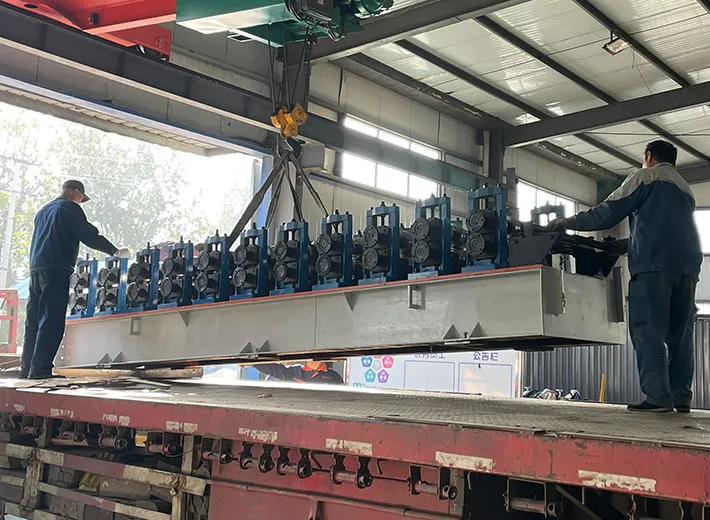
I always tell buyers the same thing: the finished product is decided long before the final cut. The uncoiler machine controls stable unwinding tension. The leveler removes stress and corrects flatness. The servo feeder machine locks in feeding length and timing. The punch press or press station creates holes, slots, and shapes that later determine assembly accuracy. Then the cold roll forming machine forms the profile gradually, which is crucial for keeping the tread straight and repeatable. Chenlong lists all of these modules as core parts of the line.
Some projects also need CNC laser welding machine support, secondary joining, or post-form operations depending on the final product family. Others add a palletizer machine or stacker to stabilize downstream packing. The real value of a strong line is not one machine. It is the way every module works together, from coil feeding equipment to finished part handling. That integrated workflow is central to Chenlong’s positioning as a roll forming machine manufacturer in China focused on custom automated lines for metal profile manufacturing.
At Chenlong, the appeal is not only machine supply. The company presents itself as an integrated manufacturer of cold roll forming equipment and profiles, with an “equipment + profiles” model, OEM/ODM customization, and one-stop workflow integration from decoiling to packaging. The company is based in Weifang, Shandong, has operated since 2006, and highlights ISO9001, CE, and SGS approvals along with 24/7 support.
That combination matters for manufacturers, distributors, and OEM partners. A buyer looking at roll forming machine manufacturers, cold forming machine manufacturers, or a roll forming machine manufacturer in China usually wants more than equipment drawings. They want process advice, tooling matching, material compatibility, installation planning, and quick communication. Chenlong says customers can send drawings, samples, material specs, or production targets and receive a tailored solution within 24 hours. For buyers trying to scale custom roll forming, custom roll form products, or custom rollform products, that speed reduces hesitation and shortens sourcing time.
Why buyers move forward
Even a well-made tread can disappoint if the installation plan is weak. Buyers need to think about grating installation details, support spacing, stair stringers, attachment points, and whether the project uses steel grating clamps, desirable grating clamps, or grating clamps of all types. In some applications, the project team compares a formed tread with a weld-assembled unit or with welded steel gratings in hot-dip galvanized finish, especially when matching an existing platform system.
I usually recommend that buyers define the full assembly environment first. Is the product for a municipal tunnel, a factory maintenance stair, a trench grating cover, a catwalk steel route, or even limited home construction use? Will it work beside stair stringers or over a drainage opening? Does it need a formed nose, hole pattern, or side plate? Those answers shape the line design. A strong supplier will not stop at the tread profile. They will ask how the product is fixed, loaded, and maintained. That is what turns a basic steel grid concept into a reliable finished system.

Before you invest, ask smart questions. Not many. Just the ones that matter.
C'est à ce stade que l'AIDA devient pratique. L'attention commence par le risque de sécurité. L'intérêt grandit lorsque vous voyez ce que l'automatisation peut faire. Le désir apparaît lorsque vous réalisez que la ligne peut réduire le travail, améliorer la qualité et soutenir plus de familles de produits. L'action vient lorsque vous partagez votre dessin et laissez le fournisseur transformer un concept en un aménagement réalisable. Si vous comparez déjà les lignes de formage à froid, c'est le moment de nous contacter et de discuter de l'objectif de production réel, pas seulement du titre de la machine.
Quelle est la différence entre une marche d'escalier en grille et une marche en acier ordinaire ?
Une marche d'escalier en grille est conçue pour améliorer le drainage et l'adhérence. Une marche ordinaire peut fonctionner à l'intérieur, mais les conceptions de marche en grille ou de marche antidérapante sont souvent meilleures pour les conditions humides, sales ou extérieures où l'adhérence est plus importante.
L'acier inoxydable est-il toujours mieux que l'acier doux ?
Pas toujours. L'acier inoxydable est excellent pour la résistance à la corrosion, mais les grilles en acier doux ou en acier carbone avec un revêtement galvanisé à chaud peuvent offrir un meilleur rapport qualité-prix lorsque l'environnement est moins agressif. La bonne réponse dépend de l'exposition, de l'entretien et du budget.
Une ligne de production peut-elle fabriquer plusieurs produits de grille ?
Souvent oui, mais cela dépend de la famille de profils, du motif de perçage, de la conception des outils et de la production requise. C'est pourquoi l'ingénierie sur mesure compte tant dans un projet de machine de formage à froid. Chenlong positionne ses lignes autour de la personnalisation flexible et des besoins de production non standards.
Les marches d'escalier en grille sont-elles disponibles avec un revêtement galvanisé à chaud ?
Oui, de nombreux acheteurs spécifient des grilles avec un revêtement galvanisé à chaud ou d'autres types avec un revêtement galvanisé à chaud pour améliorer la durabilité extérieure. C'est particulièrement courant pour l'ingénierie municipale, les grilles de passerelle en acier et les projets d'accès extérieurs.
Que se passe-t-il si mon application est sujette à l'huile ou à l'eau ?
Alors, vous devriez faire attention aux surfaces supérieures dentelées, à la géométrie antidérapante et à la conception du bord avant. Dans les zones sujettes à l'huile, l'objectif est d'améliorer la traction et de réduire le risque de glissades et de chutes.
Comment puis-je obtenir des détails et un prix sur l'équipement de production de marches en acier ?
Commencez par le dessin du produit, le type de matériau, la plage d'épaisseur, l'objectif de production et les exigences en matière de trous ou de dentelures. Chenlong dit que vous pouvez envoyer des dessins, des échantillons de profils, des spécifications de matériaux ou des objectifs de production et recevoir une solution sur mesure dans les 24 heures.
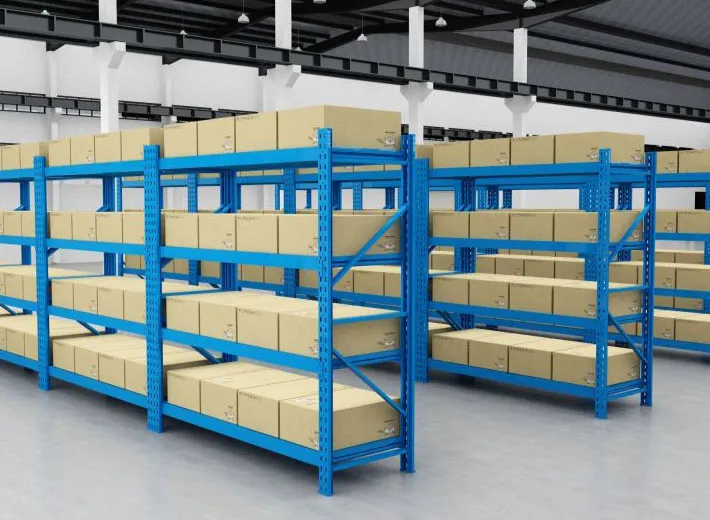
Moving a warehouse shelving line from standard to custom profiles changes four things: too…
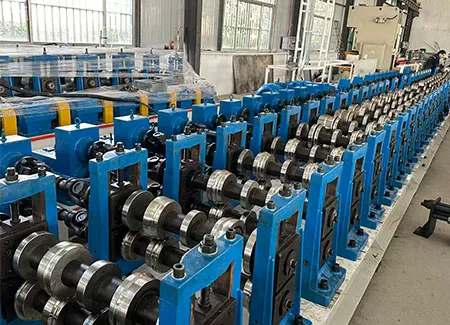
Chenlong’s roof and wall panel line is a factory-based automated roll forming system…
Nous vous répondrons dans les 24 heures. En cas d'urgence, veuillez ajouter WhatsApp/WeChat : +8613863639320,. Ou appelez directement +8613863639320.
*Nous respectons votre confidentialité et toutes les informations sont protégées.
Nous n'utiliserons vos informations que pour répondre à votre demande et n'enverrons jamais de messages électroniques ou promotionnels non sollicités.