











Empresa
20 September 2026
Warehouse Racking Systems & Shelving Production Guide
Moving a warehouse shelving line from standard to custom profiles changes four things: too…
 09:47
09:47 Chenlong Technical Team | Corporate Technical Author | Published September 3, 2026
A roll forming machine converts flat metal coil into a continuous formed profile by passing it through a series of paired rollers, each bending the metal slightly closer to its final cross-section. The process runs as one continuous line: decoiling, leveling, feeding, punching, forming, and cutting or stacking.
Unlike press braking or stamping, where a sheet enters, gets shaped, and exits before the next piece starts, roll forming runs the coil through the line without stopping between pieces. The material only stops moving when the line stops. This is why roll forming suits long runs of a fixed profile — purlins, cable trays, cabinet frames — rather than one-off custom shapes that change every piece.
Chenlong’s production lines describe this as an integrated workflow that can combine decoiling, leveling, feeding, punching, roll forming, cutting, bending, welding, and collecting/stacking into one automated sequence, with the specific stages included depending on the product line and project configuration.
The process starts with a coil of flat steel — typically several hundred kilograms to a few tonnes — mounted on an uncoiler. The uncoiler unwinds the coil at a controlled rate matched to line speed. Hydraulic and mechanical uncoiler types exist; the choice affects how much torque control the line has over coil tension as the roll gets smaller and lighter through the run.
Coil tension matters here more than it looks. Too loose, and the strip wanders side to side entering the leveler. Too tight, and the strip can develop stress marks that show up as cosmetic defects three stations downstream.
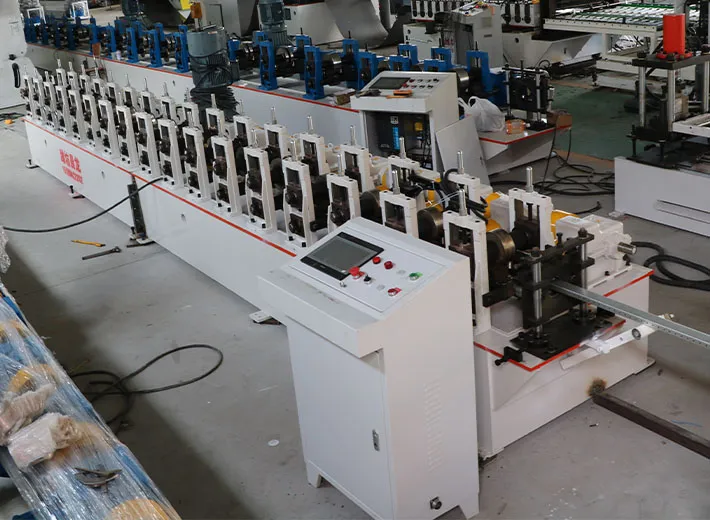
Coil steel comes off the roll with a natural curve — the “coil set” — and often some crossbow or waviness across the width. A leveler (straightener) passes the strip through a set of offset rollers that flex it back and forth until it flattens out. This step happens before feeding, not after, because a curved or wavy strip entering the roll forming stands produces an inconsistent profile that no amount of downstream adjustment can fully correct.
High-precision straightening at this stage is what determines whether the finished profile holds a straight line over a 6-meter length or drifts.
A servo feeder pulls the leveled strip into the line at a controlled, repeatable pace. This is also where punching gets synchronized, if the line includes it — the feeder has to stop or momentarily pause the strip in exact position for the punch to hit the right spot, then resume, without losing registration on the next cycle.
Common misconception here: people assume feeding is just “pushing the metal forward.” In lines with inline punching, feeding accuracy directly determines hole-to-hole spacing tolerance on the finished part — a feeder off by even a fraction of a millimeter compounds across a long production run.
Not every roll formed profile needs punching, but cabinet frames, cable trays, y shelving components often do — mounting holes, ventilation slots, or connection points. CNC and hydraulic punching machines cut these features into the flat strip before it reaches the forming rolls, while the material is still flat and easiest to work with precisely.
Punching after forming, by contrast, is harder to do accurately on a curved or boxed profile, which is part of why inline punching before the forming stations is the more common sequence.
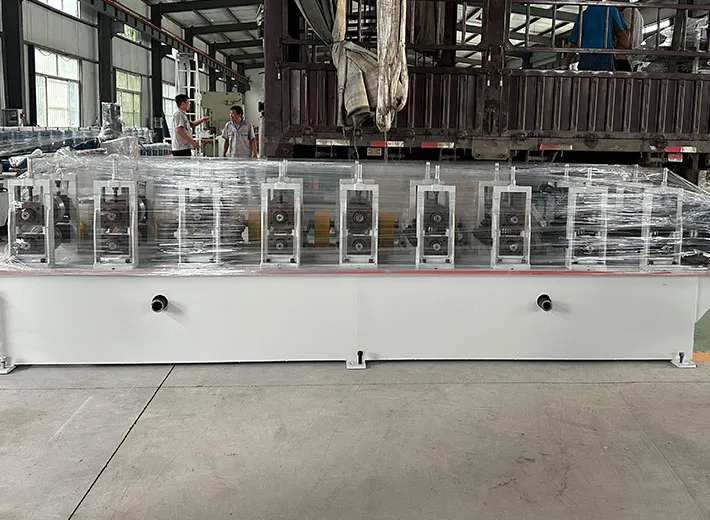
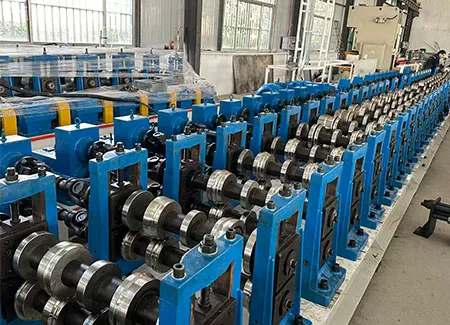
This is the stage that gives the process its name. The strip passes through a series of roll stands — pairs of contoured rollers — arranged in sequence. Each stand bends the metal a little further toward the target cross-section rather than trying to achieve the final shape in one pass.
| Roll Forming Element | Función |
| Roll stands | Each holds one matched pair (or set) of contoured rollers |
| Progressive bending | Each stand adds incremental bend angle, not full shape at once |
| Number of stands | Varies by profile complexity — simple channels need fewer than interlocking or multi-flange profiles |
| Roll set / tooling | Determines the specific profile produced; changed when switching profiles |
The number of stands a line needs depends entirely on how complex the target profile is. A simple C-channel might need fewer stands than a profile with multiple flange returns or interlocking edges, since more bend transitions require more incremental steps to avoid stressing or cracking the material.
Once the strip has taken its final profile shape, it needs to be cut to length while still moving — this is usually done with a flying cutter that travels with the strip during the cut to avoid distorting the freshly formed shape. After cutting, a receiving table or palletizer collects the finished lengths, often stacking them automatically for packaging.
Some product lines add bending or welding stations after forming, depending on whether the finished part needs additional shaping beyond what the roll stands alone can produce.
Because roll forming is continuous, an unplanned stop mid-coil creates a practical problem: the strip sitting in the forming stands when the line halts can develop a slight flat spot or mark where it was held under roller pressure without movement. Operators typically address this by reversing the line slightly before restart, or by marking and scrapping the affected section rather than shipping a length with a pressure mark. This is a routine part of running the equipment, not a defect in the machine design — but it’s the kind of practical detail generic process explainers tend to skip.
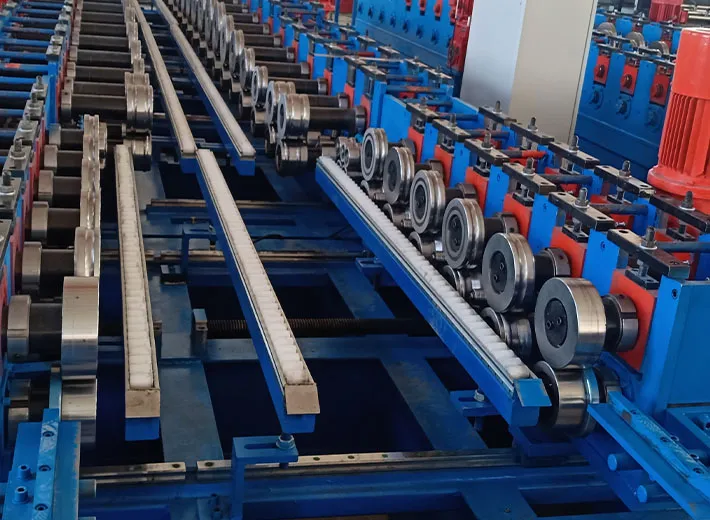
Every stage above involves either moving coil stock under tension, rotating rollers, or a punch/cutter cycling on a timer — all of which fall under standard machinery risk-assessment principles. ISO 12100:2010 sets out the general framework for identifying hazards and reducing risk in machinery design, and it’s the reference point most roll forming line safety procedures — guarding at pinch points, lockout during tooling changes, interlocks on punch stations — are built around.
A: No. Punching is included when the finished profile needs holes, slots, or connection features — common for cabinet frames, cable trays, and shelving. Profiles without those features skip this stage.
A: Bending metal too sharply in one step risks cracking or excessive stress at the bend line. Progressive forming across multiple roll stands spreads the bend across several smaller steps, which keeps the material within safe deformation limits.
A: Roll forming runs continuous coil through a line of paired rollers to produce a fixed profile at speed. Press braking bends individual flat blanks one at a time in a stamping press, which suits lower volumes or profiles that change frequently.
A: Most commonly, inadequate leveling before the strip reaches the forming stands. A wavy or curved strip entering the roll stands produces a profile that drifts, even if the forming tooling itself is correctly set.
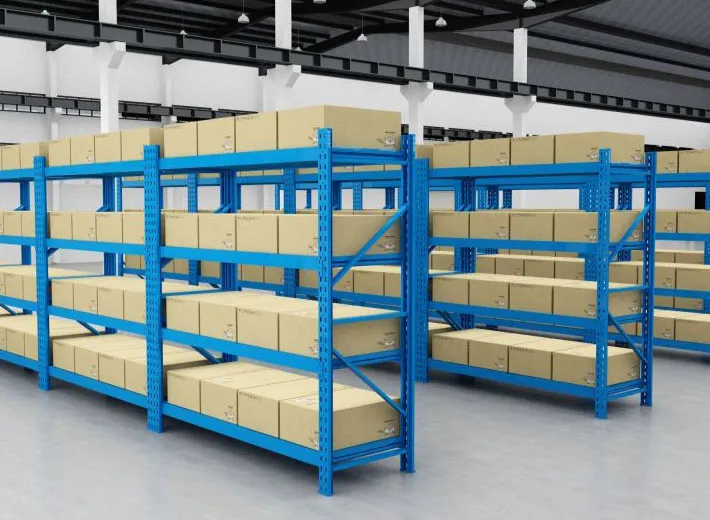
Moving a warehouse shelving line from standard to custom profiles changes four things: too…
Chenlong’s roof and wall panel line is a factory-based automated roll forming system…
Le responderemos en un plazo de 24 horas. Si para el caso urgente, por favor agregue WhatsApp/WeChat: +8613863639320,. O llame directamente a +8613863639320.
*Respetamos su confidencialidad y toda la información está protegida.
Sólo utilizaremos sus datos para responder a su consulta y nunca le enviaremos correos electrónicos o mensajes promocionales no solicitados.