











الشركة
20 September 2026
Warehouse Racking Systems & Shelving Production Guide
Moving a warehouse shelving line from standard to custom profiles changes four things: too…
 08:42
08:42 The wrong rack design can waste warehouse space, slow forklift work, and increase damage risks. The choice becomes harder when both structural and roll-formed systems appear suitable. Understanding their materials, connections, loads, costs, and production methods helps you choose with confidence.
A roll-formed pallet rack is lightweight, adjustable, and efficient for most standard warehouse applications. A structural pallet rack uses heavier steel sections and bolted connections, making it suitable for demanding loads or high-impact environments. The right choice depends on pallet weight, rack height, forklift traffic, layout, environment, and future storage needs.
A roll form pallet rack system uses steel profiles shaped continuously from metal coil. The main parts normally include upright columns, horizontal beams, braces, footplates, connectors, anchors, and safety locks.
The steel strip passes through several roller stations. Each station makes a small bend until the strip reaches its final cross-section. This roll form method creates long, repeatable components without heating or melting the material.
A typical roll formed rack provides several benefits:
A roll-formed pallet rack often uses teardrop, keyhole, or another engineered connector pattern. Installers can reposition a beam without rebuilding the entire upright frame, provided the new configuration remains within the approved load limits.
This flexibility makes roll-formed systems popular in distribution centers, retail warehouses, logistics facilities, factories, and general industrial storage buildings.
Roll-formed does not mean light-duty by definition. The profile shape, steel grade, thickness, bracing, connections, and engineering calculations determine its real performance.
A structural pallet rack normally uses heavier structural steel channels or sections. Horizontal beams usually connect to the upright with bolts instead of quick-adjustable clips.
These systems may be selected for demanding environments such as:
A structural rack is usually heavier and may take more time to install or reconfigure. However, its robust components and bolted connections can make it a suitable choice for some demanding operations.
Structural systems may use hot-rolled structural steel. The final material, section size, connection method, and surface finish depend on the design and project requirements.
A structural system is not automatically better than a roll-formed system. It solves a different set of problems. Buyers should compare the actual loads, equipment, building conditions, and working environment.
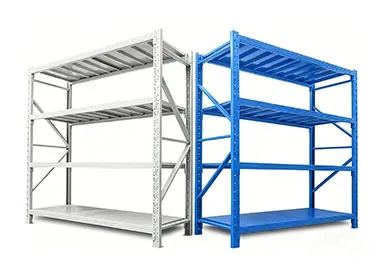
The main difference between structural pallet rack and roll-formed designs lies in how the components are made and connected.
| Comparison Point | Roll-Formed Rack | Structural Rack |
| Main Material | Formed sheet metal or coiled steel | Heavier structural steel sections |
| Manufacturing Process | Continuous roll forming | Cutting, drilling, welding, and fabrication |
| Beam Connection | Typically uses clip-in or engineered connectors | Usually uses bolted connections |
| Component Weight | Generally lighter | Generally heavier |
| Adjustment | Usually faster and easier | Often requires more labor |
| التركيب | Typically quicker | May take longer |
| Impact Resistance | Depends on the design and protective measures | Often preferred for high-impact areas |
| Production Volume | Efficient for high-volume, repetitive production | Better suited to heavier fabricated components |
| Typical Application | Standard and adjustable storage systems | Demanding warehouse environments |
| Future Reconfiguration | Usually easier | Generally less convenient |
The Rack Manufacturers Institute explains that roll-formed systems often offer flexibility, shorter installation time, and cost efficiency. Structural systems may provide greater impact resistance and more robust connections. The correct selection depends on the operation, load, environment, and handling equipment. See the RMI structural and roll-formed steel comparison.
The search term structural vs roll-formed pallet rack should not be treated as a simple “weak versus strong” comparison. Both systems can provide reliable structural integrity when engineers design them correctly and operators use them within their approved capacities.
Quick comparison
Choose a roll-formed system when you need:
Consider structural steel racking when you need:
Need help evaluating the production method? Send Chenlong your upright and beam drawings, steel specifications, load requirements, and target output for an initial manufacturing review.
The best fit depends on much more than the price of one upright or beam. The full decision must consider stored products, pallet size, maximum load, rack height, forklift type, aisle width, building conditions, and future expansion.
Begin with these questions:
A standard pallet rack system can be the right fit for your warehouse when direct access and frequent product changes matter. A heavier structural design may be more appropriate when the operation handles unusual loads or has severe impact risks.
| Warehouse Requirement | Recommended Starting Point |
| Frequent Beam-Level Adjustments | Roll-formed racking system |
| Direct Access to Every Pallet | Selective pallet racking |
| Heavy Industrial Operations | Structural steel racking |
| High-Volume Rack Production | Roll-formed steel profiles |
| First-In, First-Out Inventory | Pallet flow racking system |
| High-Density Storage | Drive-in, push-back, or mobile racking system |
| Hand-Loaded Cartons | Warehouse shelving |
| Mixed Product Types | Combined shelving and racking system |
| Frequent Forklift Impacts | Structural design or reinforced protection |
| Frequently Changing Product Sizes | Adjustable roll-formed racking system |
The final answer should come from engineering data. A sales label such as “heavy duty” does not define the load capacities, connection behavior, or allowable height.
How Do Pallet Loads and Rack Height Affect the Decision?
A designer must know the maximum pallet weight, dimensions, load distribution, number of positions per level, and total number of levels. The stated load capacities should apply to the complete configuration rather than one component in isolation.
Important load information includes:
| Required Information | Why It Matters |
| Maximum Pallet Weight | Determines the required beam and upright capacity |
| Load Width and Depth | Defines support requirements and necessary clearances |
| Load Height | Determines vertical spacing between levels |
| Pallet Construction | Affects how the load rests on and transfers weight to the system |
| Loads per Level | Determines the total load demand on each beam level |
| Number of Levels | Affects the total loading on the rack frame |
| Uneven Load Distribution | May create concentrated or localized stress |
| Future Product Changes | May require revisions to the approved racking design |
As a rack gets taller, horizontal movement, frame stability, anchoring, and bracing become more important. A tall rack carrying light goods may behave differently from a shorter system carrying heavy loads.
An upright frame combines vertical columns with diagonal and horizontal braces. The frame transfers forces through the baseplates and anchors into the floor. Upright profile shape, steel grade, material thickness, hole pattern, and bracing arrangement all matter.
The horizontal beam carries each pallet level. Beam length, cross-section, connector design, steel properties, and load placement affect deflection and capacity. Accurate roll formed beams help connectors align with the upright slots and make installation more consistent.
ANSI MH16.1-2023 addresses the structural design, testing, and use of industrial steel storage racks made with cold-formed and hot-rolled members. Project teams should follow the applicable edition, local requirements, engineering documents, and manufacturer instructions. An overview is available from the American National Standards Institute.
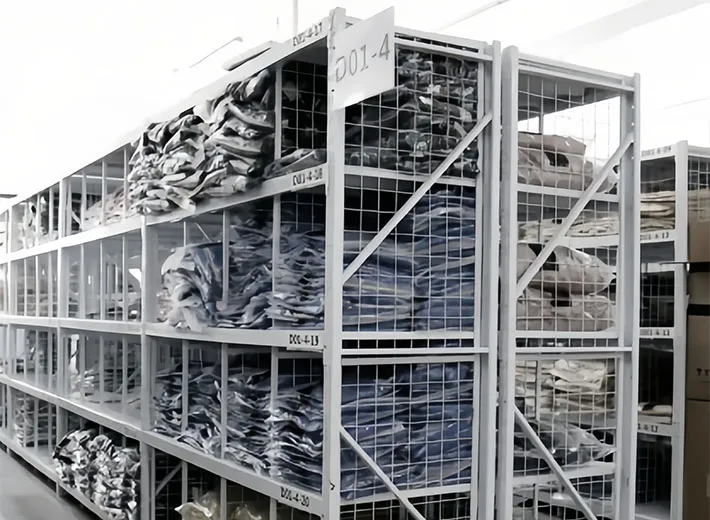
The forklift is part of the storage system. It controls aisle width, turning space, lifting height, load placement, and impact exposure.
A layout should account for:
Busy warehouse operations create more opportunities for impact. Upright guards, end barriers, clear traffic lanes, operator training, lighting, and regular inspection can help reduce damage.
A structural system may be considered where lift-truck impacts are frequent or severe. However, using thicker steel does not remove the need for guards, training, inspection, and damage reporting.
Roll-formed racking can still perform well in active facilities when the design is suitable and vulnerable areas are protected. The decision should reflect actual warehouse operations rather than assumptions.
Many types of pallet racking use roll-formed profiles. The best storage solution depends on access, stock rotation, density, handling equipment, and product range.
Selective pallet racking
Selective pallet racking provides direct access to each load. It normally uses upright frames and horizontal beams arranged in single or back-to-back rows.
A selective pallet layout works well for facilities that store many SKUs and need regular access to each product. It is one of the most flexible warehouse storage options.
Drive-in and drive-through racking
These systems allow a forklift to enter a storage lane. They reduce the number of aisles and increase density, but they provide less direct access to individual loads.
Guide rails, support rails, braces, and upright frames must work together. The operating procedure is also important because the truck moves inside the structure.
Pallet flow racking
A pallet flow system uses inclined rollers or wheels. Products enter from one side and move toward the picking side, supporting first-in, first-out inventory control.
The rack profiles must support the roller lanes, loads, brakes, guides, and other moving components.
Push-back racking
Push-back systems store several loads in depth on carts or roller tracks. Each new load pushes the previous one farther into the lane.
Mobile pallet racking
Mobile rows move along floor rails to open an aisle where access is needed. The system increases density but requires controls, sensors, electrical systems, and detailed engineering.
The correct type of warehouse storage must balance capacity, selectivity, product flow, safety, and available warehouse space.
A complete rack system includes more than frames and beams. Every component affects assembly, performance, and safe use.
Common components include:
The upright includes repeated slots or holes for beam connections and bracing. Punching accuracy matters. If the slot position varies, beam levels may not align across the row.
The beam supports each storage level. Some systems use box beams, step beams, open profiles, or reinforced sections. The connector must match the upright pattern and approved design.
Manufacturers should not mix unknown beams, connectors, frames, or safety locks simply because the parts appear to fit. Similar dimensions do not prove compatibility.
For warehouse shelving and hand-loaded goods, manufacturers may also produce shelf panels, edge sections, back panels, support channels, and reinforcement profiles. These shelving systems require a different load and access assessment from forklift-loaded pallet structures.
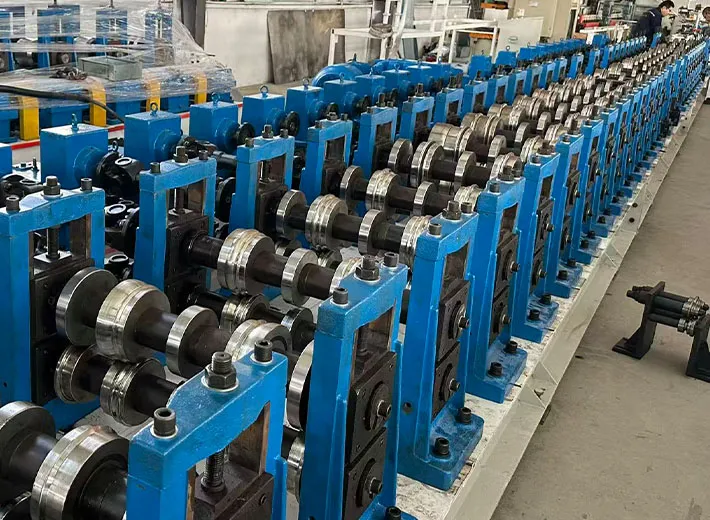
Roll-formed profiles usually begin as metal coil. Many are made from cold-rolled steel, although galvanized, pre-painted, stainless, and suitable high-strength grades may also be used.
The roll forming process generally follows these steps:
A cold roll forming operation bends the material at room temperature. Each roller station changes the shape gradually. This helps control the finished cross-section and reduces stress from attempting one large bend.
A continuous roll form line is especially useful for long parts with a repeated cross-section, including:
A roll-formed profile is not defined only by its outer dimensions. Manufacturers must also control straightness, twist, bow, hole spacing, cut length, surface quality, and connector fit.
Structural alternatives may use a hot-rolled structural channel. These parts normally follow a different production route involving cutting, drilling, welding, and other fabrication processes.
Both structural and roll formed systems require controlled materials, qualified production, suitable inspection, and correct assembly.
A customized roll forming machine can connect operations that were previously handled by separate equipment. Feeding, leveling, punching, forming, cutting, receiving, and optional stacking can run as one coordinated process.
Potential manufacturing benefits include:
Consider a manufacturer producing rack uprights in several lengths. In a disconnected process, workers measure the strip, punch the slots, move the material, form the profile, cut each section, and inspect the finished part.
Every transfer adds time. Small punching or positioning errors may also accumulate.
An automated line uses servo feeding to control the slot positions. Forming stations shape the profile continuously, and the cut-off system produces the programmed length. This supports a more stable roll formed racking system manufacturing process.
Chenlong’s automatic production line for warehouse and supermarket shelving can be configured for uprights, beams, shelf panels, support sections, and related components. Optional punching and slotting functions can be integrated according to the product.
Automation does not replace sound profile design. It makes a well-developed process more repeatable.
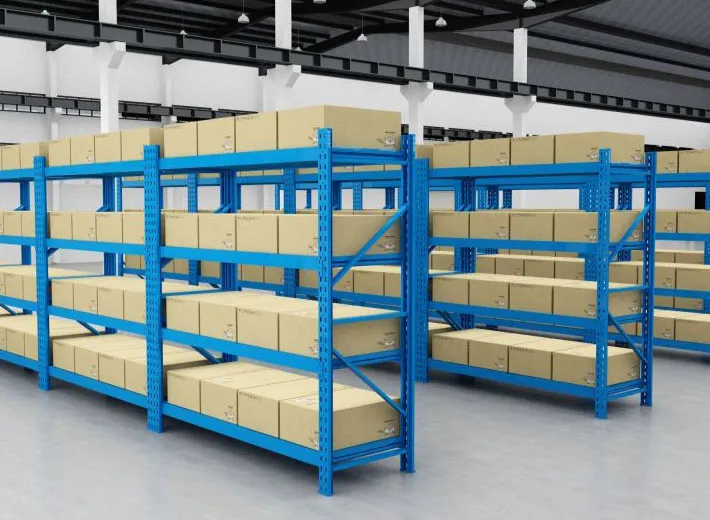
A machine supplier cannot develop a reliable production line from a product name or photograph alone. Detailed technical information reduces risk and shortens the design process.
Prepare the following information:
| Required Information | Example or Details |
| Profile Type | Upright, beam, shelf panel, or brace |
| Profile Drawing | 2D or 3D technical drawing |
| Material | Steel grade and coating specifications |
| Thickness | Minimum and maximum thickness range |
| Coil Width | Strip width before roll forming |
| Hole Pattern | Hole dimensions and spacing |
| Cut Length | Minimum and maximum profile length |
| Tolerance | Critical dimensional requirements |
| Production Speed | Meters or pieces produced per minute |
| Annual Output | Expected annual production volume |
| Product Range | Number of profile specifications |
| Changeover Target | Manual, adjustable, or automatic changeover |
| Receiving Method | Table, conveyor, or automatic stacker |
| Factory Information | Available voltage and installation floor space |
If one machine must make several profiles, explain which dimensions change. Closely related products may use adjustable stands, while different cross-sections may need separate roller sets.
For structural pallet rack and roll-formed products in one catalog, the factory may need different manufacturing equipment. Structural sections often require drilling, welding, and fabrication. Roll-formed parts are better suited to continuous coil processing.
Manufacturers should also provide information about the final assembly. Understanding how the beam connects to the upright helps the equipment supplier identify critical punching positions and forming tolerances.
Chenlong can review the complete pallet rack and roll-formed pallet product family to determine which profiles can share feeding, punching, cutting, or receiving processes.
Weifang Chenlong Intelligent Technology Co., Ltd. is a high-tech company based in Shandong, China. We specialize in high-precision cold bending equipment, customized automated production lines, and shaped metal profiles.
Our roll-formed steel profiles for warehouse shelving and industrial racking can support:
We work with manufacturers, distributors, and OEM partners rather than positioning ourselves as a retail warehouse equipment seller. Our role is to help customers produce stable metal profiles and improve their manufacturing processes.
Illustrative manufacturing case
A manufacturer wants to produce adjustable uprights for an industrial warehouse. The profile uses repeated connector slots, several cut lengths, and a critical mounting surface.
Our team reviews the drawing, material, thickness, slot pattern, production volume, and required tolerance. We then study the forming sequence, punching method, roller design, cut-off system, and receiving process.
If the customer also produces beams and shelf panels, we evaluate which production stages can be shared. This helps the factory avoid unnecessary duplicate equipment while maintaining product quality.
Chenlong’s warehouse light-duty racking solutions connect profile development with equipment engineering. Buyers can also explore our complete range of warehousing field profiles and production equipment.
A roll-formed system commonly uses shaped sheet-steel profiles and adjustable connectors. A structural system normally uses heavier steel sections and bolted connections. Both require an engineered design based on load, height, environment, and operating conditions.
Yes, it can support substantial loads when correctly designed, tested, manufactured, and installed. However, racking may require heavier structural sections in unusually demanding applications. The responsible engineer should review the full configuration.
Not in every comparison. Strength depends on material grade, thickness, profile geometry, bracing, connections, rack height, and load arrangement. “Structural” and “roll-formed” describe broad construction methods rather than guaranteed capacity levels.
Uprights and beams often require different rollers, punching tools, and cut-off systems. Some feeding, control, or receiving equipment may be shared. Chenlong can review the profile family and recommend a practical configuration.
A roll-formed pallet rack generally allows faster beam-level changes because it often uses clip-in connectors. Structural systems commonly use bolts and may require more labor to reconfigure.
We need drawings or samples, material grade, thickness, coil width, profile dimensions, punching pattern, cut length, tolerance, production speed, and annual output. Information about the complete rack and roll-formed pallet rack assembly is also valuable.
The choice between structural and roll-formed racking affects component weight, connections, installation, adjustment, production equipment, and total cost. There is no universal winner.
Roll-formed systems provide flexibility, efficient material use, adjustable beam levels, and scalable production for many standard warehouse applications. Structural systems may be more suitable for severe impact conditions, robust bolted connections, or specialized heavy-duty projects.
The same principle applies to manufacturing equipment. The best line is not simply the fastest machine. It must form accurate profiles, maintain critical dimensions, position holes correctly, and match the factory’s product range.
If your current process relies on repeated measuring, separate punching, manual bending, or excessive material transfers, an integrated production line may improve consistency and efficiency.
Weifang Chenlong Intelligent Technology Co., Ltd. provides customized cold forming equipment and metal profile solutions for global racking manufacturers, distributors, and OEM partners.
Contact Chenlong with your profile drawings, steel grade, thickness range, punching pattern, cut lengths, target speed, and annual output. Our engineers will evaluate your requirements and propose a practical production solution that is the right fit for your warehouse product range.
Moving a warehouse shelving line from standard to custom profiles changes four things: too…
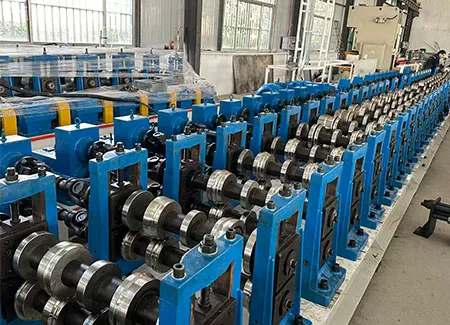
Chenlong’s roof and wall panel line is a factory-based automated roll forming system…
سوف نرد عليك خلال 24 ساعة. إذا كانت الحالة عاجلة، يرجى إضافة واتساب/وي تشات: +8613863639320، أو الاتصال مباشرة على +8613863639320.
*نحن نحترم خصوصيتك وجميع المعلومات محمية.
سنستخدم معلوماتك فقط للرد على استفسارك ولن نرسل أبدًا رسائل بريد إلكتروني غير مرغوب فيها أو رسائل ترويجية.